



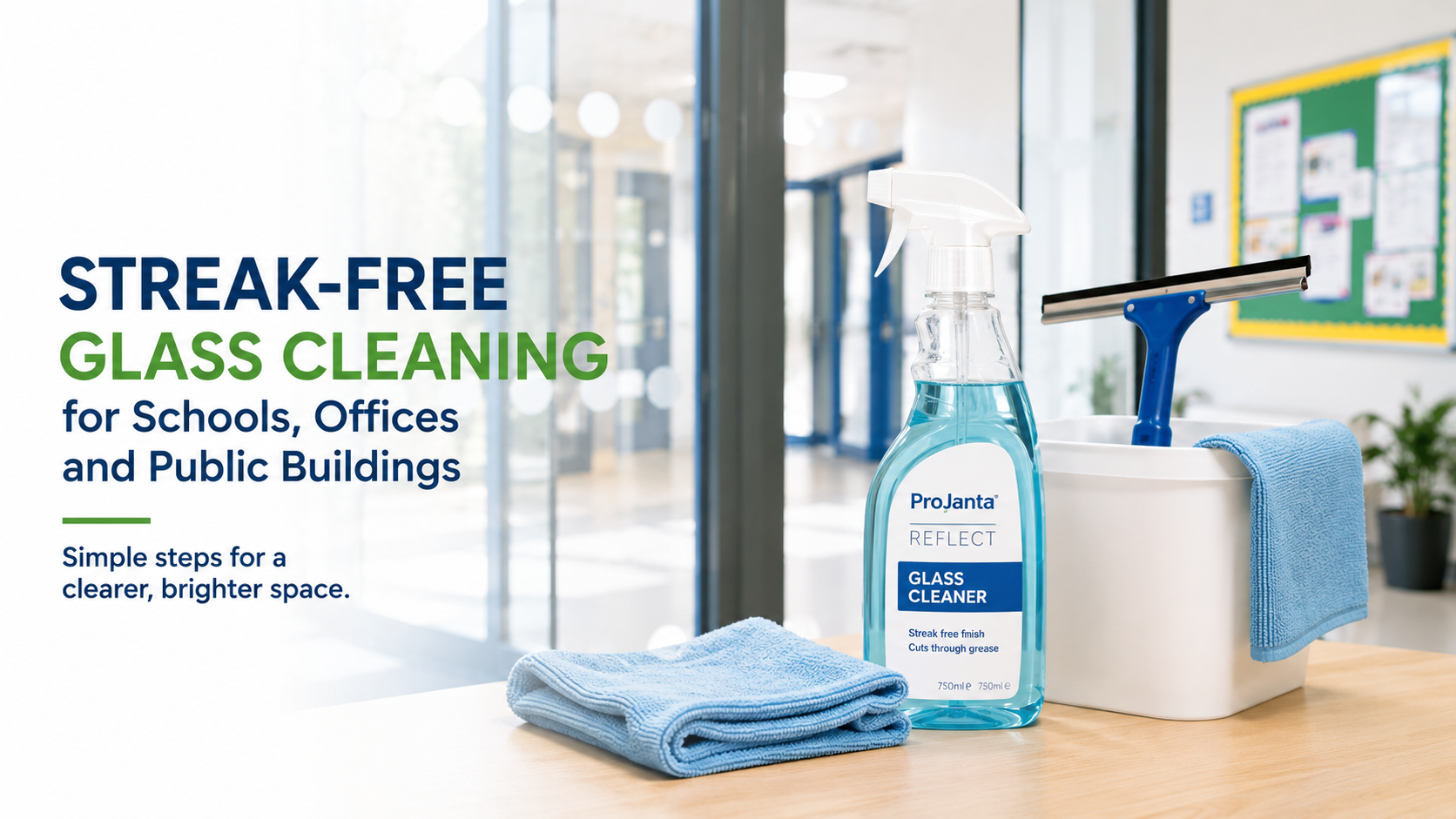
Glass is one of the first things people notice in a school, office or public building. Entrance doors show fingerprints before reception has opened. Mirrors in washrooms pick up water marks throughout the day. Internal partitions collect smears from hands, bags and cleaning cloths that have been used once too often.
That is why choosing the right glass cleaners is not just about shine. It affects first impressions, cleaning time, user confidence and the way light moves through a building. In schools, clean glazing can make corridors, classrooms and reception areas feel brighter. In offices, streak-free partitions and meeting room glass help the space look professionally managed.
At Express Cleaning Supplies, we treat glass cleaning as part of everyday site presentation. Our glass cleaner range includes ready-to-use sprays, concentrated window cleaning solutions, mirror cleaner options, commercial glass cleaning products and supporting equipment such as microfibre cloths, lint-free wipes and squeegees. The aim is simple, clean glass without over-spraying, residue or repeated rework.
Why glass cleaning often goes wrong
Most streaks are caused by method, not just product choice. A good streak-free glass cleaner can still leave marks if cleaners use too much spray, work with dirty cloths or clean in direct sunlight where the product dries too quickly.
In busy buildings, the problem often starts with speed. Cleaners spray too heavily, wipe once, then move on. The surface looks better from one angle, but as soon as daylight hits it, smears show across the glass.
Glass also sits in awkward places. School entrance doors, display boards, internal windows, lift mirrors and office partitions all get touched frequently, but they are rarely cleaned in one smooth pass. As a result, the same areas are repeatedly spot-cleaned, while edges, corners and lower panels collect residue.
A better approach is to treat glass as a finish surface. It needs the right product, a clean cloth, light application and a consistent wiping pattern.
What a professional glass cleaner should do
A professional glass cleaner should lift fingerprints, grease, water marks, airborne dust and light residues without leaving a film behind. It should also dry quickly enough to reduce smearing, but not so quickly that cleaners cannot work the surface properly.
For schools and offices, low odour products are often preferable because cleaning may happen while the building is occupied. In addition, ready-to-use sprays make sense for quick touchpoint cleaning, while 5 litre refills or concentrates can reduce cost per use across larger sites.
Express Cleaning Supplies’ glass cleaner category is designed for schools, offices, healthcare settings, hospitality, housekeeping departments and facilities teams. The range includes products for windows, mirrors, doors, partitions, stainless steel, chrome and glazed ceramics, with options available in 750ml sprays and 5 litre formats.
Choosing glass cleaners by area
School entrance doors and reception glazing
School entrance doors need frequent attention because they collect fingerprints, palm marks and weather-related smears. They also carry high visibility. Parents, governors, contractors and visitors often see this area before anywhere else.
For glass cleaning for schools, we usually recommend a simple daily touchpoint routine. Clean door handles and push plates separately first, then clean the glass panels with a suitable glass cleaner and a clean microfibre cloth. If the same cloth handles dirty frames and glass, streaks will follow.
Products such as ProJanta Reflect Glass Cleaner, Selden Glaze Glass Cleaner and Christeyns Clover Brite Glass Cleaner sit within our glass cleaner range and are suitable examples for professional glass cleaning tasks. These are the types of products schools can use for routine glass, window and mirror maintenance.
Office partitions and meeting rooms
Office glass is different because people view it close up. Meeting room partitions, glass doors and glazed office fronts show smears clearly, especially under bright lighting.
An office glass cleaner should therefore support fast drying and low residue. Staff should also avoid over-spraying near desks, screens, paperwork and sockets. In practice, it is often better to spray the cloth lightly rather than spray directly onto every panel.
For larger offices, 5 litre refill products can make sense. Cleenol Edencleen Window & Glass Cleaner 5L is one option listed in our glass cleaners category, while 750ml products such as Mirius Super Glass and Stainless Steel Cleaner can support daily spot cleaning in shared areas.
Mirrors, washrooms and display boards
Mirror cleaner for washrooms
Washroom mirrors usually collect water spots, soap splash and fingerprints. However, they also sit near dispensers, sinks and tiles, so cleaners often use the wrong product out of convenience.
A proper mirror cleaner should leave the surface clear without haze. Cleaners should avoid using toilet cleaner, descaler or general washroom chemical on mirrors unless the label clearly allows it. The wrong product can leave residue, damage edges or create smearing that takes longer to correct.
For washroom mirrors, spray sparingly and wipe from top to bottom. Then buff with a dry section of cloth. If water spots remain, check whether the issue is hard water splash from taps, poor ventilation or too much product being applied.
Display boards and internal glazing
Schools often use glass, acrylic or clear display covers in corridors and reception areas. These surfaces pick up dust and fingerprints, but they may not tolerate every glass product in the same way. Therefore, always check surface compatibility before using a cleaner on plastic or coated display panels.
Where reflective surfaces include stainless steel or UPVC, products such as Q-Eco GlassTab can be useful. Q-Eco GlassTab is designed for glass, mirrors, stainless steel, UPVC and reflective surfaces, and it works by adding one tab to water in a trigger bottle. It is a practical option where schools and offices want refillable cleaning products and lower storage demand.
Cloth choice matters more than people think
A good glass cleaner cannot compensate for a dirty cloth. Lint, old detergent, fabric softener residue and trapped grit can all cause smears or scratches.
For best results, use a clean, dry, lint-free cloth or microfibre wipe. Express Cleaning Supplies’ own guidance recommends light spray application, systematic top-to-bottom cleaning and polishing as you go to avoid streaks. For larger surfaces, a squeegee can save time and help maintain a clear finish.
Microfibre works well because it lifts fine residues from the surface rather than simply moving them around. However, cloths need proper laundering. If glass cloths are washed with greasy catering cloths or heavy washroom mop heads, they may pick up residues that later transfer onto windows and mirrors.
In practice, large schools and offices should keep dedicated glass cloths separate from general cleaning cloths. Colour coding can help, but only if staff understand and follow the system.
How to avoid over-spraying
Over-spraying is one of the most common causes of poor glass cleaning. Too much product leaves wet edges, drips onto frames and creates residue at the bottom of panels.
The right technique is controlled and light:
- Use one or two sprays for a small mirror or panel.
- Spray the cloth instead of the surface near desks, sockets or paper.
- Work top to bottom so any moisture moves downwards.
- Wipe edges and corners where residue collects.
- Buff with a dry cloth face if the panel still looks hazy.
- Replace the cloth when it becomes damp or dirty.
This approach saves product and reduces rework. It also helps cleaners move more quickly because they are not chasing wet lines across the surface.
Cleaning frequency by building type
Glass cleaning frequency should follow use, not habit. A quiet office window may need weekly attention, while a school entrance door may need cleaning several times a day.
Schools
For schools, daily checks should cover entrance doors, reception glazing, pupil washroom mirrors and high-touch internal panels. Weekly routines can then cover classroom internal windows, display covers and lower traffic mirrors.
During school holidays, site teams should also clean higher-level internal glass, corridor display panels and hard-to-reach partitions. This is especially useful before open evenings, September returns and inspection windows.
Offices
For offices, reception doors, meeting room glass and washroom mirrors usually need daily or near-daily cleaning. Internal windows, glazed screens and low-touch partitions may suit a weekly schedule.
If an office has glass-heavy meeting rooms, cleaners should check the glass after peak booking periods rather than only at the end of the week.
Public buildings
Public buildings need a risk-based routine. Reception screens, entrance doors, lift mirrors and customer-facing glass should sit high on the schedule. Back-office windows can usually sit lower unless they affect light, visibility or presentation.
Safety considerations for glass cleaning
Glass cleaning can look low risk, but it still needs control. Chemicals should be stored safely, staff should avoid unnecessary skin contact, and cleaning areas should be well ventilated where products are used. HSE COSHH guidance for cleaning tasks highlights safe storage, good work techniques, suitable PPE where needed and proper ventilation.
Window cleaning can also create working-at-height risks. HSE guidance says employers should avoid work at height where reasonably practicable, for example by using telescopic water-fed poles or cleaning windows from the inside. Work at height must be properly planned, supervised and carried out by competent people using suitable equipment.
There is also a slip risk. Spray drift, dripping solution or water from exterior cleaning can leave smooth floors damp. HSE guidance advises cleaning in sections, leaving smooth floors dry after cleaning, or excluding pedestrians until floors are dry.
Commercial glass cleaning products to keep in stock
Most facilities teams do not need a large glass cleaning cupboard. They need the right mix for daily use, refills and specialist situations.
A practical stock list includes:
- Ready-to-use glass cleaner for daily spot cleaning.
- 5 litre refill glass cleaner for high-use buildings.
- Refillable trigger bottles where concentrates or tablets are used.
- Lint-free microfibre cloths reserved for glass only.
- Squeegees for larger panes and internal glass.
- Scrapers where suitable, used only by trained staff.
- Window cleaning poles for safer access where appropriate.
- PPE where product guidance requires it.
Within our range, schools and offices can choose from products such as ProJanta Eco Logik Glass Cleaner 750ml, ProJanta Reflect Glass Cleaner, Selden Window Cleaner with Vinegar, Cleenol Edencleen Window & Glass Cleaner 5L and Q-Eco GlassTab. The right choice depends on whether the site needs ready-to-use convenience, refill efficiency, eco-conscious cleaning or concentrated stock control.
Common mistakes to avoid
The first mistake is using too much product. Glass should be lightly covered, not soaked.
The second mistake is cleaning glass with general cloths. If the cloth has been used for desks, sinks or stainless steel, it may leave residues behind.
The third mistake is cleaning in the wrong conditions. Direct sun, hot glass or poor lighting can make streaks more likely and harder to see until later.
The fourth mistake is ignoring frames and edges. Dirt from frames can move onto glass as soon as the cloth touches the border.
Finally, do not use a general cleaner on coated screens, plastic display panels or specialist surfaces without checking compatibility first. A streak-free result is only useful if the surface remains undamaged.
Practical checklist for streak-free glass cleaning
Use this checklist for schools, offices and public buildings:
- Match the glass cleaner to the surface and setting.
- Use clean, dry microfibre or lint-free cloths.
- Keep glass cloths separate from washroom and catering cloths.
- Spray lightly, avoiding drips and overspray.
- Work from top to bottom in a consistent pattern.
- Buff with a dry cloth face if needed.
- Use squeegees for larger panes.
- Clean frames separately where soil is visible.
- Schedule high-touch glass more often than low-touch windows.
- Plan work-at-height tasks properly and use competent staff.
- Store products safely and follow label instructions.
FAQs
What is the best streak-free glass cleaner for schools?
The best option depends on the surface and routine. Ready-to-use sprays work well for daily entrance doors and mirrors, while Q-Eco GlassTab or 5 litre refills can support larger sites that want refillable or lower waste systems.
How often should schools clean glass doors?
Busy entrance doors may need daily cleaning, and sometimes more during wet weather, events or open evenings. Internal classroom windows and display panels can usually follow a weekly or termly schedule depending on use.
What causes streaks on mirrors?
Streaks usually come from over-spraying, dirty cloths, product residue or wiping without a dry buff. Water splash and soap residue can also make washroom mirrors harder to clean.
Should offices use a different glass cleaner from schools?
Not always. The bigger difference is routine. Offices often need regular cleaning of partitions and meeting room glass, while schools usually need stronger focus on entrance doors, display panels and washroom mirrors.
Are eco glass cleaners suitable for commercial buildings?
Yes, where they perform properly and suit the surface. Products such as ProJanta Eco Logik Glass Cleaner and Q-Eco GlassTab can support commercial cleaning teams that want more sustainable cleaning supplies without losing clarity.
What equipment helps with large glass panels?
Squeegees, poles, lint-free cloths and suitable glass cleaners all help. For work at height, the task must be properly planned and carried out by competent people using suitable equipment.
At Express Cleaning Supplies, we see glass cleaning as a small task with a visible impact. With the right glass cleaners, cloths, technique and schedule, schools, offices and public buildings can keep windows, mirrors, partitions and display surfaces clear, bright and properly maintained.