



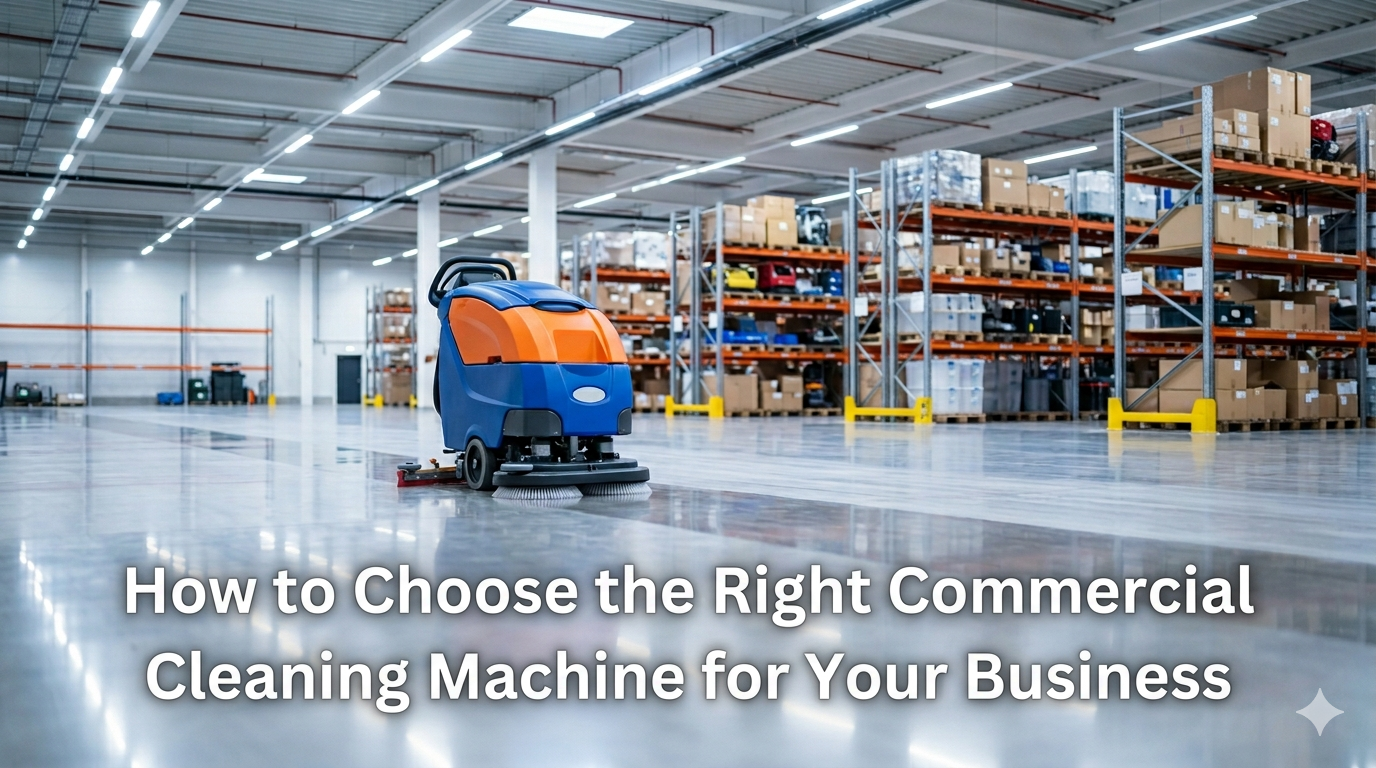
A practical buyer's guide to commercial cleaning machines for UK businesses — the different machine types, how to match them to your environment, what to look for in a specification, and whether to buy or lease.
Choosing a commercial cleaning machine is one of the most significant purchasing decisions a facilities manager, cleaning contractor, or business owner will make. The right machine reduces cleaning time, improves hygiene standards, and pays for itself quickly in reduced labour costs. The wrong machine — purchased without matching its specification to the environment — ends up underperforming, breaking down prematurely, or sitting unused because it does not suit the space.
This guide cuts through the confusion and gives you a clear framework for choosing the right commercial cleaning machine for your business — whether you are running a busy hotel, a warehouse, a school, a care home, or a retail environment. Browse our full commercial cleaning machines range once you know what you need.
Commercial cleaning machines represent a significant investment, and the difference between the right and wrong choice is not just performance — it is total cost of ownership over the machine's working life.
- Labour cost reduction. A commercial scrubber dryer can clean a large floor area in a fraction of the time it would take with a mop and bucket — consistently reducing the hours spent on floor cleaning and freeing staff for other tasks.
- Hygiene consistency. Mechanical cleaning delivers a more consistent result than manual cleaning. Scrubber dryers, for example, apply the same pressure, chemical concentration, and drying action across the entire floor on every pass — removing the variability of manual mopping.
- Compliance. In regulated environments — healthcare, food production, education — hygiene standards are inspected and enforced. The right machine helps you meet and demonstrate compliance.
- Chemical efficiency. Modern commercial cleaning machines are designed to work with specific dilution ratios of cleaning chemicals, reducing product waste and ensuring the correct concentration is applied consistently. Pairing the right machine with the right chemicals from our chemical concentrates range maximises both performance and economy.
- Floor surface protection. Using a machine with incorrect brush pressure or pad type for a particular floor surface causes accelerated wear. A machine matched correctly to the floor type extends the life of your flooring.
Types of Commercial Cleaning Machines
Understanding the different machine categories is the starting point for any purchasing decision. Each type is designed for a specific cleaning task — and many businesses need more than one.
Matching the Machine to Your Environment
The most common purchasing mistake is choosing a machine based on price or brand rather than matching the specification to the specific environment. The questions below provide a framework for the right decision.
| Environment | Primary Machine | Secondary Machine | Key Consideration |
|---|---|---|---|
| Office (hard floors) | Walk-behind scrubber dryer | Commercial vacuum | Quiet operation — machine must be usable during or after business hours |
| Office (carpeted) | Commercial upright vacuum | Carpet extractor (periodic) | HEPA filtration for air quality — important in open-plan offices |
| Hotel / Hospitality | Commercial vacuum (HEPA) | Carpet extractor + scrubber dryer | Low noise essential — battery-powered models preferred for occupied areas |
| Healthcare / Care Home | HEPA-filtered vacuum | Steam cleaner + scrubber dryer | Infection control — HEPA filtration and steam sanitisation non-negotiable |
| School / Education | Walk-behind scrubber dryer | Commercial vacuum | Compact size for corridors — must be operable by non-specialist staff |
| Warehouse / Industrial | Ride-on sweeper-scrubber | Pressure washer | High capacity — large tanks and wide cleaning path to cover large areas efficiently |
| Retail | Walk-behind scrubber dryer | Commercial vacuum | Compact design — must manoeuvre around displays and shelving |
| Food Production | Scrubber dryer (washdown rated) | Hot water pressure washer | IP-rated for wet environments — must withstand regular chemical washdowns |
| Car Park / External | Ride-on sweeper | Pressure washer | Weather-resistant — outdoor-rated models essential |
Once you have identified the right machine type, comparing specifications across models helps you select the right size and capability for your specific space and cleaning frequency.
For Scrubber Dryers
- Cleaning path width — measured in centimetres. A wider path covers more floor per pass, reducing cleaning time. Wider machines are faster but less manoeuvrable in tight spaces. Match the cleaning path width to the width of your corridors and open floor areas.
- Tank capacity (solution and recovery) — measured in litres. Larger tanks mean fewer refill and empty cycles during a cleaning session. For large floor areas, choose a machine with a tank capacity that allows a full cleaning cycle without stopping.
- Battery life (for battery-powered models) — measured in hours. Ensure the battery life matches or exceeds your longest cleaning session. Lithium-ion batteries charge faster and maintain consistent power throughout the cycle — preferable to lead-acid batteries for most commercial applications.
- Brush pressure — measured in kg or bar. Higher brush pressure is needed for heavily soiled floors. Too much pressure on delicate floor surfaces causes damage. Look for models with adjustable brush pressure.
- Noise level — measured in dB. Critical for hotels, healthcare, and offices where cleaning may take place during occupied hours. Battery-powered models are significantly quieter than mains-powered equivalents.
For Commercial Vacuums
- Motor power (watts or air watts) — higher power delivers greater suction. Air watts is the more accurate measure of actual cleaning performance than input watts.
- Filtration grade — HEPA filtration (H13 or H14) is required for healthcare and any environment where captured particles must not re-enter the air. Standard filtration is sufficient for most office and retail environments.
- Dust capacity — larger dust containers mean less frequent emptying. Important for high-volume environments with heavy soiling.
- Cord length or battery life — for large floor areas, cord length determines how often you need to move the plug. Battery-powered cordless models eliminate this constraint entirely.
Buying vs Leasing — Which Is Right for You?
For many UK businesses, leasing a commercial cleaning machine makes more financial sense than outright purchase — particularly for higher-value machines such as ride-on scrubber dryers. Express Cleaning Supplies offers machine leasing options alongside outright purchase. Visit our machine leasing page for full details.
| Factor | Buying | Leasing |
|---|---|---|
| Upfront cost | High — full purchase price | Low — monthly payments spread the cost |
| Ownership | You own the machine outright | Machine returned or upgraded at end of term |
| Maintenance | Your responsibility | Often included in lease agreement |
| Technology upgrades | Purchase new machine when needed | Upgrade to newer model at end of lease term |
| Balance sheet | Asset appears on balance sheet | Operating cost — does not affect asset position |
| Best for | Businesses with capital available and long-term, stable requirements | Businesses wanting to preserve cash flow or upgrade regularly |
Chemicals and Consumables to Use With Your Machine
A commercial cleaning machine is only as effective as the chemicals used with it. Using the wrong concentration or an incompatible product can reduce cleaning performance, damage the machine, or leave residues on floor surfaces that attract dirt and resoil faster.
- Floor cleaning chemicals for scrubber dryers — always use a low-foam formulation designed specifically for use in machine tanks. Standard mop bucket detergents produce excessive foam inside the recovery tank, damaging the vacuum motor. Browse our floorcare cleaning products for compatible options.
- Concentrated chemical ranges — our chemical concentrates range provides professional-grade cleaning chemicals at the correct dilution ratios for machine use. Concentrated products are significantly more cost-effective per litre of working solution than ready-to-use alternatives.
- Carpet extraction chemicals — use only low-residue formulations designed for hot water extraction machines. High-residue products leave a sticky layer in carpet fibres that attracts fresh dirt and causes rapid resoiling. See our carpet cleaning chemicals range.
- Brush pads and consumables — scrubber dryer brush pads and squeegee blades require regular replacement. Using worn pads significantly reduces cleaning performance. View our cleaning machine spares range for replacement parts.
- Vacuum filters and bags — HEPA filters must be replaced at the manufacturer's recommended intervals to maintain filtration efficiency. A clogged filter reduces suction power and — in HEPA applications — allows fine particles to bypass the filter and re-enter the air. View our machine spares and consumables.
Maintaining Your Cleaning Machine
A commercial cleaning machine that is not maintained correctly will underperform and fail prematurely. The following routine keeps machines in working condition and extends their operational life significantly.
Frequently Asked Questions
Browse Our Commercial Cleaning Machines Range
Scrubber dryers, vacuums, carpet extractors, pressure washers, and all the chemicals and spares to run them — with free UK delivery on orders over £75 plus VAT.
Browse Cleaning Machines → ???? 03300 538 737