



No classroom can be made completely allergen free. Pupils bring pollen in on clothes, dust gathers on shelves, soft furnishings hold particles and mould can appear where moisture problems go unresolved. However, schools can reduce allergen load with the right cleaning routines, equipment and product choices.
For head teachers, site managers and procurement teams, the aim is not to create a sterile room. It is to support allergen-free classrooms as far as reasonably possible by controlling dust, improving cleaning methods and reducing avoidable triggers for allergy-prone pupils and staff.
At Express Cleaning Supplies, we approach classroom cleaning for allergies as a practical system. HEPA vacuums, microfibre cloths, controlled damp dusting, careful floorcare and sensible mould response all matter. So does timing, because cleaning can temporarily disturb dust if it happens immediately before a room is occupied.
What allergy-friendly school cleaning can and cannot do
Allergy-friendly school cleaning reduces exposure. It does not remove every allergen. Dust mites, pollen, mould spores and fine dust can all return quickly if cleaning schedules, ventilation and room layout do not work together.
Government guidance says good ventilation is essential for healthy and productive learning environments because it brings in fresh outdoor air and removes stale indoor air. In practice, cleaning and ventilation should support each other, especially in busy classrooms that remain occupied for long periods.
UKHSA guidance for education settings also recommends cleaning frequently touched surfaces and clearly describing cleaning schedules, including what must be done, how often and who will carry it out. Although that guidance focuses on infection prevention, the same discipline helps with dust and allergen control.
The key is consistency. One deep clean before inspection will not help if dust builds up again on ledges, blinds, display shelving and carpet edges.
The main allergen sources in classrooms
Classrooms collect allergens in predictable places. Desks and shelves gather dust. Carpets and rugs hold fine particles. Soft seating, curtains and fabric displays can trap pollen and dust mites. Meanwhile, damp corners, window frames and poorly ventilated storage areas can create conditions where mould becomes a concern.
NHS patient guidance on dust mites recommends vacuuming at least weekly, damp dusting weekly and using HEPA-filter vacuum cleaners where the person cleaning has a dust mite allergy. It also advises reducing clutter and avoiding heavy curtains where dust mite exposure is a concern.
Schools do not need to copy home allergy advice exactly. However, the principles translate well. Reduce dust reservoirs. Use cleaning methods that capture particles rather than spread them. Keep soft materials under review. Improve airflow where the room allows it.
HEPA vacuums for dust control in classrooms
A standard vacuum can remove visible debris, but it may not be the best tool for fine dust and allergens. For dust control in classrooms, filtration matters.
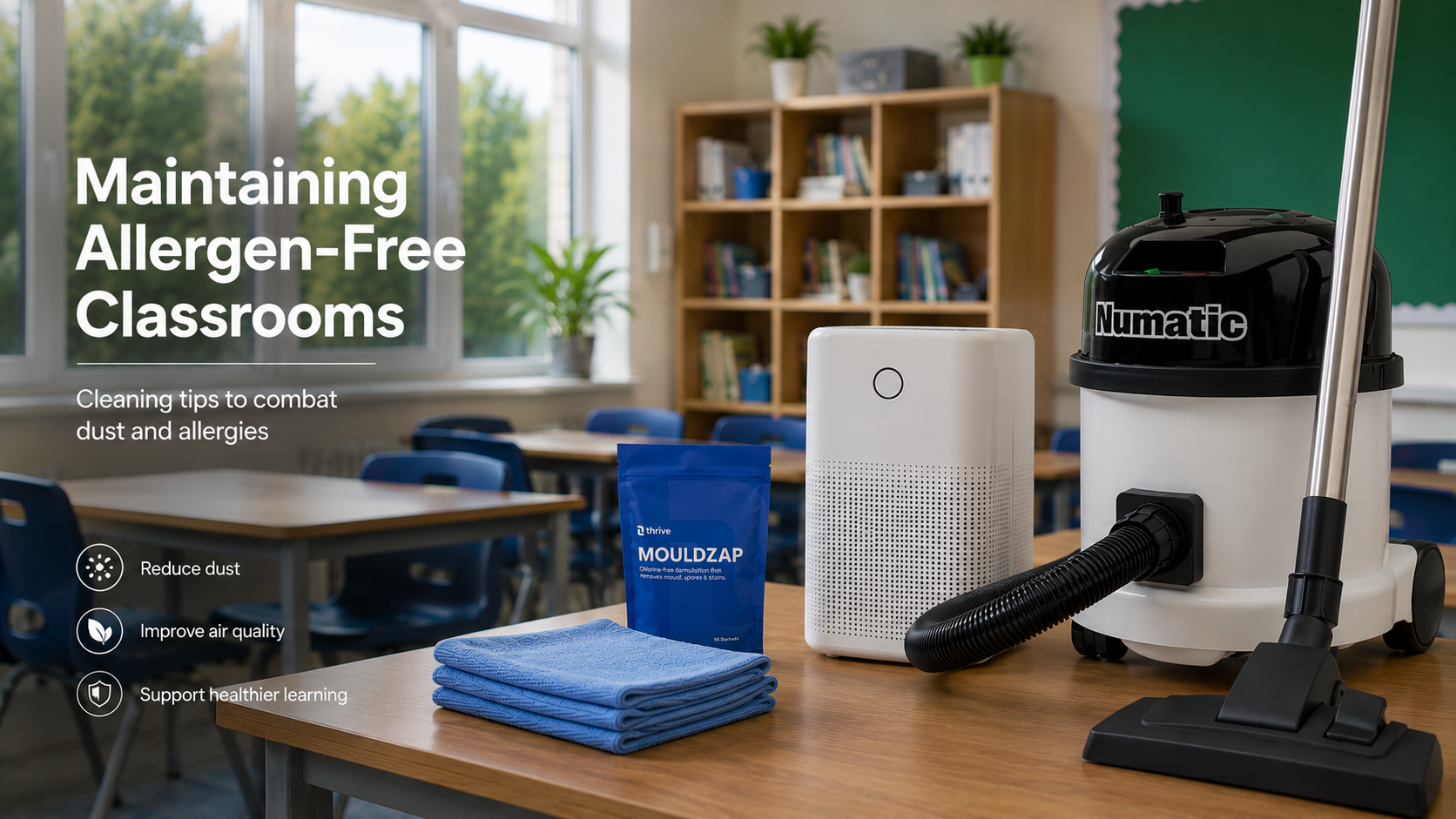
Express Cleaning Supplies stocks HEPA vacuum options that are relevant to allergy-sensitive environments. The Numatic NVR170 HEPA Vacuum has 3-stage H13 filtration, HepaFlo bags that lock in dust for safe disposal and on-board tool storage for practical daily use. The product page specifically notes that it captures fine dust, pollen and allergens.
The Victor V-9 9L HEPA Tub Vacuum is another suitable example. It is listed with certified 99.9984% HEPA filtration to capture fine particles, allergens and bacteria, plus a 600W motor and stable 5-castor design.
In schools, the best vacuum is the one staff will use correctly. It should be easy to empty, stable in tight rooms and fitted with the right floor tools for carpets, hard floors and edges.
Microfibre cloths and damp dusting
Dry dusting often moves particles from one surface to another. Damp dusting with microfibre is usually a better approach because it captures dust more effectively and reduces airborne disturbance.
Express Cleaning Supplies’ microfibre cloths range includes colour-coded cloths for different cleaning zones. The site notes that colour coding helps prevent cross-contamination, with blue often used for general cleaning, red for washrooms, green for catering and yellow for specialist areas.
For schools working on both allergy control and sustainability, the Vileda R-MicroTuff Swift Microfibre Cloths are a useful option. They are made from 100% recycled materials and remove greasy finger marks and stubborn dirt without the use of chemicals.
In practice, classrooms should have a regular damp-dusting route. Start high, then work down. Clean shelves, window ledges, display rails, door plates, table tops and chair backs. Then vacuum or mop floors after dust has settled.
Floors, carpets and soft furnishings
Floor type affects allergen control. Hard floors can be easier to clean thoroughly, but they still need proper dust removal before mopping. Otherwise, damp mopping can move fine debris around the room.
Microfibre flat mop heads help here because they physically remove soil and can be laundered and reused. Express Cleaning Supplies’ microfibre flat mop range is described as suitable for schools and commercial premises, with colour-coded options and compatibility across floor types such as vinyl, laminate, tiles and sealed wood.
Carpeted classrooms need a different routine. Vacuuming frequency should reflect footfall, not just a generic schedule. High-use rooms, libraries, early years areas and carpeted offices may need more frequent attention, plus periodic carpet cleaning between terms.
Soft seating also needs planning. If fabric chairs, cushions or reading rugs cannot be cleaned properly, they can become long-term dust reservoirs. For this reason, schools should keep soft furnishings minimal in allergy-sensitive rooms.
Mould, damp and pollen control
Mould is not just a cleaning issue. If moisture remains, mould will return. Schools should treat visible mould as a sign to check ventilation, leaks, condensation and building fabric before relying on repeated surface treatment.
Where a suitable cleaning product is required, Express Cleaning Supplies stocks THRIVE Mouldzap Mould Remover Powder, which is listed as chlorine-free, non-toxic, pH-neutral and safe for washable surfaces when used as directed. The product page also says it is designed to eliminate mould, spores and stains from hard and soft surfaces in environments including schools.
However, any mould treatment still needs care. HSE guidance on cleaning products says some ingredients can cause skin allergies and asthma, and recommends safe storage, good work techniques, suitable PPE where needed and good ventilation.
Pollen control is different. During high pollen periods, schools may need to review open-window routines, cloakroom cleaning and end-of-day vacuuming. The aim is to remove tracked-in pollen before it circulates again the next day.
Timing matters more than people think
Cleaning can disturb dust before it removes it. Therefore, allergy-focused cleaning is best carried out after pupils have left, giving particles time to settle and rooms time to ventilate before the next day.
This matters most for vacuuming, high-level dusting and moving stored materials. If staff clean immediately before pupils enter, sensitive pupils may notice symptoms even when the room looks clean.
A practical routine might look like this:
- Clear visible clutter weekly so surfaces can be cleaned properly.
- Damp dust desks, ledges and shelves after the school day.
- Vacuum carpets with a HEPA vacuum after dusting.
- Mop hard floors with microfibre systems after dry soil has been removed.
- Wash or remove soft furnishings that cannot be maintained.
- Check window frames, corners and storage areas for damp or mould.
- Record recurring problem rooms and review ventilation or building issues.
That turns allergen control from a one-off reaction into a managed process.
Products that support allergy-friendly classrooms
Schools do not need a large product list. They need a focused one.
Useful choices include:
- Numatic NVR170 HEPA Vacuum for fine dust, pollen and allergen capture.
- Victor V-9 HEPA Tub Vacuum for compact classroom and office vacuuming.
- Vileda R-MicroTuff Swift Microfibre Cloths for low-chemical surface cleaning.
- Quattro or Robert Scott microfibre cloths for colour-coded daily cleaning.
- SYR Microfibre Flat Mop Heads for hard floors and dust-sensitive areas.
- THRIVE Mouldzap for appropriate mould treatment where the underlying moisture issue is being addressed.
This is not about buying specialist products for every room. Instead, schools should standardise good core equipment and use it consistently.
Common mistakes to avoid
The first mistake is relying on fragrance. A room that smells fresh is not necessarily low in allergens. In fact, strong fragrances can be uncomfortable for some sensitive users.
The second mistake is dry dusting high shelves and then stopping. That can simply move dust into the breathing zone. Damp dusting followed by floor cleaning works better.
The third mistake is ignoring storage. Old projects, fabric displays, spare cushions and cluttered cupboards all collect dust. If a room is difficult to clean, the allergen load will usually rise.
The fourth mistake is treating mould as cosmetic. Cleaning visible mould may improve appearance, but moisture control prevents recurrence.
Practical checklist for allergen-free classrooms
Use this checklist for classrooms, libraries, offices and SEND spaces:
- Use HEPA vacuums where fine dust and allergens are a concern.
- Damp dust with microfibre rather than dry dusting.
- Reduce clutter on shelves, windowsills and cupboard tops.
- Clean high-touch surfaces as part of the daily routine.
- Vacuum after dusting, not before.
- Use colour-coded cloths to separate classrooms, washrooms and food areas.
- Review soft furnishings and remove items that cannot be cleaned.
- Check window frames, corners and storage areas for damp or mould.
- Ventilate rooms where possible and follow school ventilation guidance.
- Keep cleaning schedules clear, signed off and reviewed termly.
FAQs
Can schools create completely allergen-free classrooms?
No. Pollen, dust and other particles will always enter the building. However, schools can reduce allergen levels with HEPA vacuuming, damp dusting, clutter reduction, ventilation and good cleaning schedules.
Are HEPA vacuums worth it for schools?
Yes, especially in classrooms, libraries, offices and SEND spaces. HEPA vacuums help capture fine dust, pollen and allergens rather than simply moving them around the room.
How often should classrooms be vacuumed for allergies?
At least weekly is a sensible baseline for low-risk areas, but high-footfall rooms may need more frequent vacuuming. NHS guidance on dust mite reduction recommends weekly vacuuming and damp dusting.
Is microfibre better for classroom dusting?
Yes. Microfibre cloths capture dust and dirt effectively, especially when used damp. Colour-coded microfibre also helps schools separate classroom, washroom and catering cleaning.
What should schools do about mould in classrooms?
Treat visible mould carefully, but also find the moisture source. Check leaks, condensation, ventilation and storage conditions. Use suitable mould treatment only as directed and follow COSHH controls.
What is the best starting point for allergy-friendly school cleaning?
Start with dust reservoirs. Reduce clutter, damp dust surfaces, vacuum with HEPA filtration and review carpets, rugs and soft furnishings. Then build those tasks into the cleaning schedule.
At Express Cleaning Supplies, we see allergy-focused cleaning as a practical routine, not a specialist add-on. With the right vacuums, microfibre systems, mould response and scheduling, schools can create cleaner, more comfortable classrooms for pupils and staff without overcomplicating the cleaning programme.