



By the end of the summer term, school floors usually tell the story of the year. Corridors show heel marks and trolley routes. Dining halls carry grease and drink residues. Classrooms collect scuffs, chair drag marks and patches of dull finish. Meanwhile, halls and entrances take the impact of wet weather, mud, assemblies, PE lessons and community use.
That is why school floorcare works best when it is planned before the holiday begins. The summer break gives site teams a rare opportunity to clean, strip, polish and protect hard floors without trying to work around pupils every hour. However, the work still needs structure, because drying time, access, product choice and floor type all affect the result.
At Express Cleaning Supplies, we see floorcare for schools as a practical maintenance process, not just a one-off shine. Our floorcare range includes mops, sweepers, floor cleaning chemicals, floor pads, polish, sealers, signs and machine accessories, so schools can build a routine that suits real buildings, real staffing and real turnaround times.
Why end-of-term floorcare needs a plan
A good summer holiday floor clean does two jobs. It improves appearance before pupils return, and it protects the floor from wear during the next term.
However, the main mistake is leaving everything until the final week of August. Floor work is not just cleaning. Some tasks need dwell time, rinse time, drying time and, where polish or sealer is used, curing time. As a result, a rushed job can leave streaks, residue, patchy gloss or slippery areas.
In practice, schools should plan summer holiday floor cleaning around building access. Lettings, maintenance contractors, exam results days, staff training and holiday clubs can all interrupt floorcare work. For this reason, we recommend mapping rooms and corridors by priority, then agreeing which areas must be completed first.
Start with a floor survey
Before choosing products, walk the site and identify the floor types. Vinyl, linoleum, sealed wood, safety flooring, tiles and polished concrete do not all need the same method.
A survey should also record damage, failing polish, ingrained dirt, loose edges, poor matting and areas that become slippery when damp. This helps avoid over-treating floors that only need a deep clean, while also identifying floors where polish or sealer has genuinely worn away.
The highest priority areas are usually:
- Main entrances and reception routes
- Corridors and stair landings
- Dining halls and serving routes
- Assembly halls and sports hall edges
- Classrooms with visible chair marks
- Toilets and washroom approaches
- Staff rooms and offices with dull or patchy finish
This first step saves time because it stops the same product being used everywhere.
Clean before you polish
No floor polish for schools will perform properly if dirt and detergent residue remain underneath it. Therefore, the first stage is always soil removal.
Dry sweep or vacuum first to remove grit, dust and debris. Then clean with the correct floor chemical for the surface and soil level. Express Cleaning Supplies’ floor cleaning chemical range includes neutral cleaners for polished floors, alkaline degreasers for kitchens and heavy duty products for ingrained dirt, as well as low foam detergents for scrubber dryers and rotary machines.
For larger areas, a scrubber dryer or compact floor machine can help reduce labour and improve consistency. Our i-mop range, for example, can be paired with different brushes and pads for floor types such as vinyl, tile, stone and safety flooring. That gives schools more control than relying on one mop system for every area.
Managing slip risk during cleaning
Floorcare should improve safety, not create new hazards. HSE guidance advises using the right amount of the right cleaning product, allowing detergent enough time to work, maintaining equipment properly and leaving smooth floors dry after cleaning or keeping people away until the floor is dry.
For schools, this matters because contractors, staff and holiday club users may still move through the site. Clean in zones, use clear access control and avoid leaving wet routes across entrances or corridors. Warning signs help, but they do not replace proper drying time or restricted access.
When to strip old polish
Stripping removes old floor polish, ingrained residue and failed coatings. It is a bigger job than routine school floor cleaning, and it should not be done unless the floor actually needs it.
Signs that stripping may be required include yellowing, patchy gloss, sticky residue, deep scuffs trapped under polish, or polish flaking near doorways and chair routes. On the other hand, if the floor finish is still sound, a deep clean and polish maintainer may be enough.
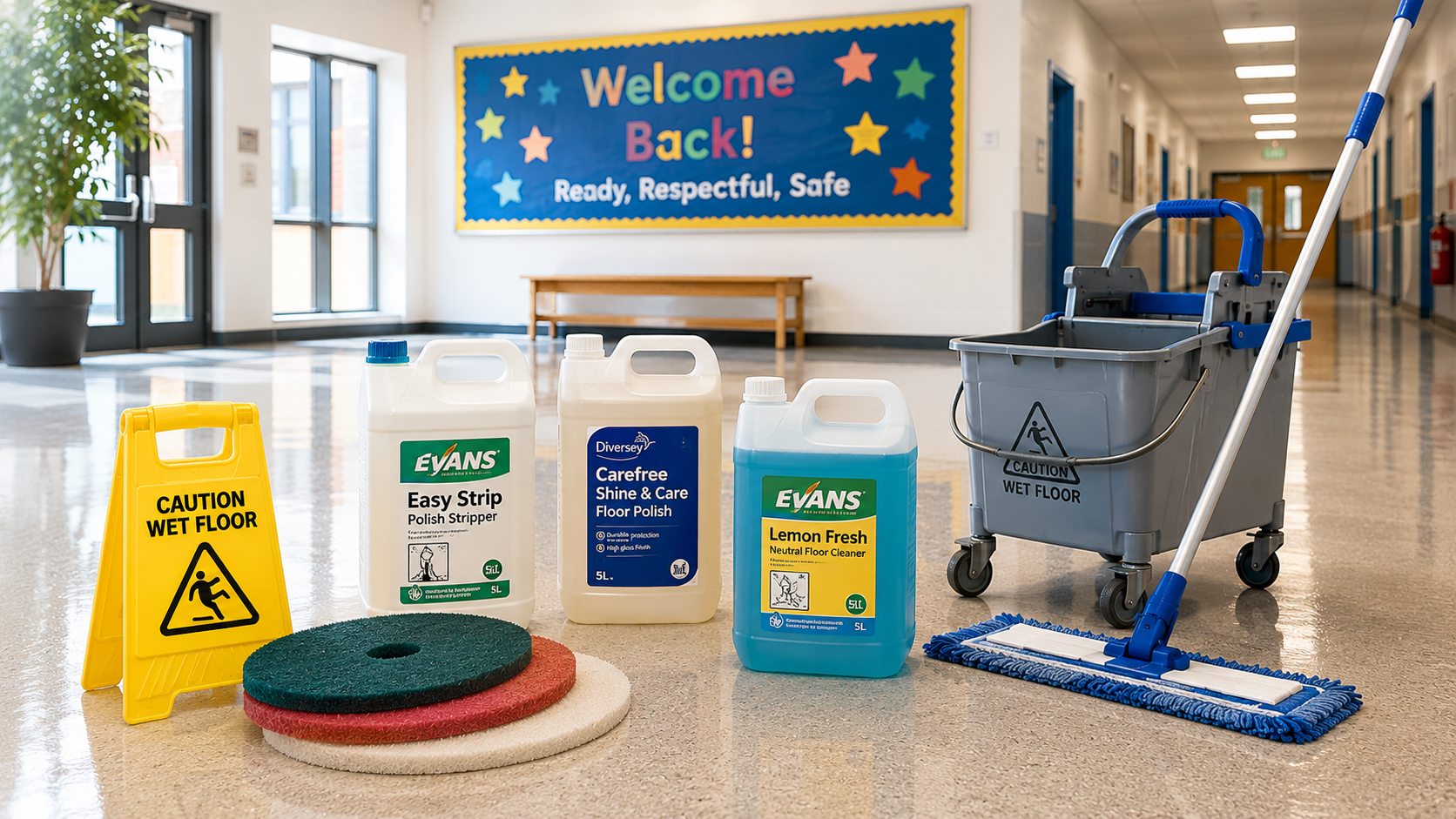
For stripping work, we stock products such as Evans Easy Strip Polish Stripper 5L, which is designed for fast removal of floor polish and can be used on vinyl, rubber, linoleum and sealed floors. It is also suitable for spray stripping systems and mop stripping in smaller or confined areas.
However, stripping needs careful control. Staff must follow dilution instructions, wear appropriate PPE, ventilate the area and rinse thoroughly where the product guidance requires it. If residue remains, new polish may not bond correctly.
Polishing and protecting hard floors
Once the floor is properly cleaned or stripped, polish and sealer can help protect the surface and improve appearance. This is especially useful in corridors, halls and entrances where footfall is heavy.
Express Cleaning Supplies’ polish, wax and sealer category explains that polishes and sealers can improve appearance, create a barrier against dirt, moisture and abrasion, and help preserve flooring materials. Many products are also formulated to provide slip resistance while maintaining shine.
A relevant product example is Diversey Carefree Shine & Care Polish 5L, formerly Eternum. It is a high gloss floor polish designed for heavy traffic areas, with resistance to scuff marks, dirt and grime.
In practice, polish should be applied in thin, even coats. More product does not mean better protection. Too much polish can increase drying time, cause build-up and make later maintenance harder.
Choosing the right floor pads
Floor pads make a major difference to the finish. The wrong pad can under-clean, over-strip or damage the surface.
Standard floor pads are commonly used for scrubbing, buffing, polishing and stripping. Express also stocks 3M Scotch-Brite floor pads for cleaning, polishing and general maintenance tasks.
For schools wanting lower chemical maintenance, Twister Floor Pads are worth considering. These diamond impregnated pads use microscopic diamonds to clean and polish hard floors mechanically, helping to remove dirt and micro scratches while creating a smoother, glossier finish.
KGS Diamond Floor Pads are another option for staged hard floor maintenance. The range uses different grades for different parts of the process, including deeper cleaning and polishing stages.
The key is to match the pad to the floor, machine speed and task. If in doubt, test a small area first.
School corridor cleaning, where most wear shows
Corridors need special attention because they connect every part of the site. If corridors look dull on the first day back, the whole building feels tired.
For school corridor cleaning, start by removing loose grit from edges, corners and skirting. Then machine clean the main walking route and pay attention to door thresholds, locker areas and bends where scuffing is common. If polish is needed, schedule corridors early enough to allow full drying before furniture, deliveries or staff movement resume.
At the same time, review entrance matting. A polished corridor will not stay clean if wet shoes and grit are carried straight in from outside. Good matting reduces soil load and protects the work you have just paid for.
Classrooms, halls and dining areas
Classrooms often need less aggressive treatment than corridors, but they still need careful preparation. Chair legs, table movement and daily footfall create dull patches and scuffs, especially around teaching positions and doorways.
Assembly halls and dining areas need a more robust approach. Food residue, drink spills and grease can affect cleaning results, so detergents must be matched to the soil. Meanwhile, any polish or sealer used in these spaces should suit the floor type and expected traffic.
Dining halls also need sensible timing. If catering teams need access during the holidays, floorcare should happen after deep kitchen cleaning and before final room setup. Otherwise, trolleys and equipment may mark a freshly polished floor.
Stock and equipment checklist for summer floorcare
Before the summer break begins, check that the site team has the right stock available. Last-minute ordering often leads to substitutions, and substitutions can affect finish.
A practical floorcare checklist includes:
- Neutral floor cleaner for polished or sensitive floors
- Low foam detergent for scrubber dryers
- Heavy duty cleaner or degreaser for dining and entrance areas
- Floor polish stripper where old polish needs removing
- Floor polish or sealer suited to the surface
- Floor maintainer for ongoing gloss control
- Correct floor pads for scrubbing, stripping and polishing
- Mop systems, buckets, wringers and microfibre mop heads
- Floor signs and access control equipment
- Machine spares, brushes, pads and squeegees
- PPE, including gloves and eye protection where required
This kind of list helps procurement teams buy properly without overloading cupboards with products that do the same job.
Common mistakes to avoid
The first mistake is polishing over dirt. It traps marks under the finish and makes the next clean harder.
The second mistake is using too much chemical. Excess detergent can leave residue, while excess polish can build up unevenly.
The third mistake is ignoring drying time. Floors may look dry before they are ready for heavy use, especially after stripping or polishing.
The fourth mistake is using one pad for every task. Scrubbing, buffing, stripping and polishing need different grades and different levels of abrasion.
Finally, do not forget machine maintenance. A worn squeegee, dirty tank or wrong pad can spoil an otherwise well-planned floorcare job.
FAQs
What is the best time for summer holiday floor cleaning?
The best time is usually early to mid-holiday, once rooms are clear and before contractors or staff start resetting the building. This gives enough time for cleaning, drying, polish application and any rework.
Do all school floors need polish?
No. Some floors only need a deep clean or floor maintainer. Polish should be used where the surface is suitable and where added protection or appearance improvement is needed.
How do schools know when to strip a floor?
Stripping may be needed when polish looks yellowed, patchy, sticky or heavily scuffed. If the finish is still sound, stripping may be unnecessary and may add cost without improving the result.
What floor pads should schools use?
It depends on the task. Stripping, scrubbing, buffing and polishing all require different pad types. Schools should match the pad to the floor surface, machine and product being used.
How can schools reduce slip risk after floor cleaning?
Use the correct product dilution, remove residue, clean in sections, restrict access while floors are wet and allow enough drying time. HSE guidance also recommends leaving smooth floors dry after cleaning or excluding pedestrians until dry.
What should schools buy from Express Cleaning Supplies for floorcare?
Most schools need a mix of floor cleaning chemicals, mop systems, floor pads, polish or sealer, floor signs and machine accessories. For larger sites, scrubber dryers, i-mop systems and compatible pads can make school floorcare faster and more consistent.
At Express Cleaning Supplies, we help schools choose floorcare products by surface, traffic and turnaround time. Done properly, end-of-term floorcare protects hard floors, improves appearance and gives pupils and staff a cleaner, safer building to return to in September