



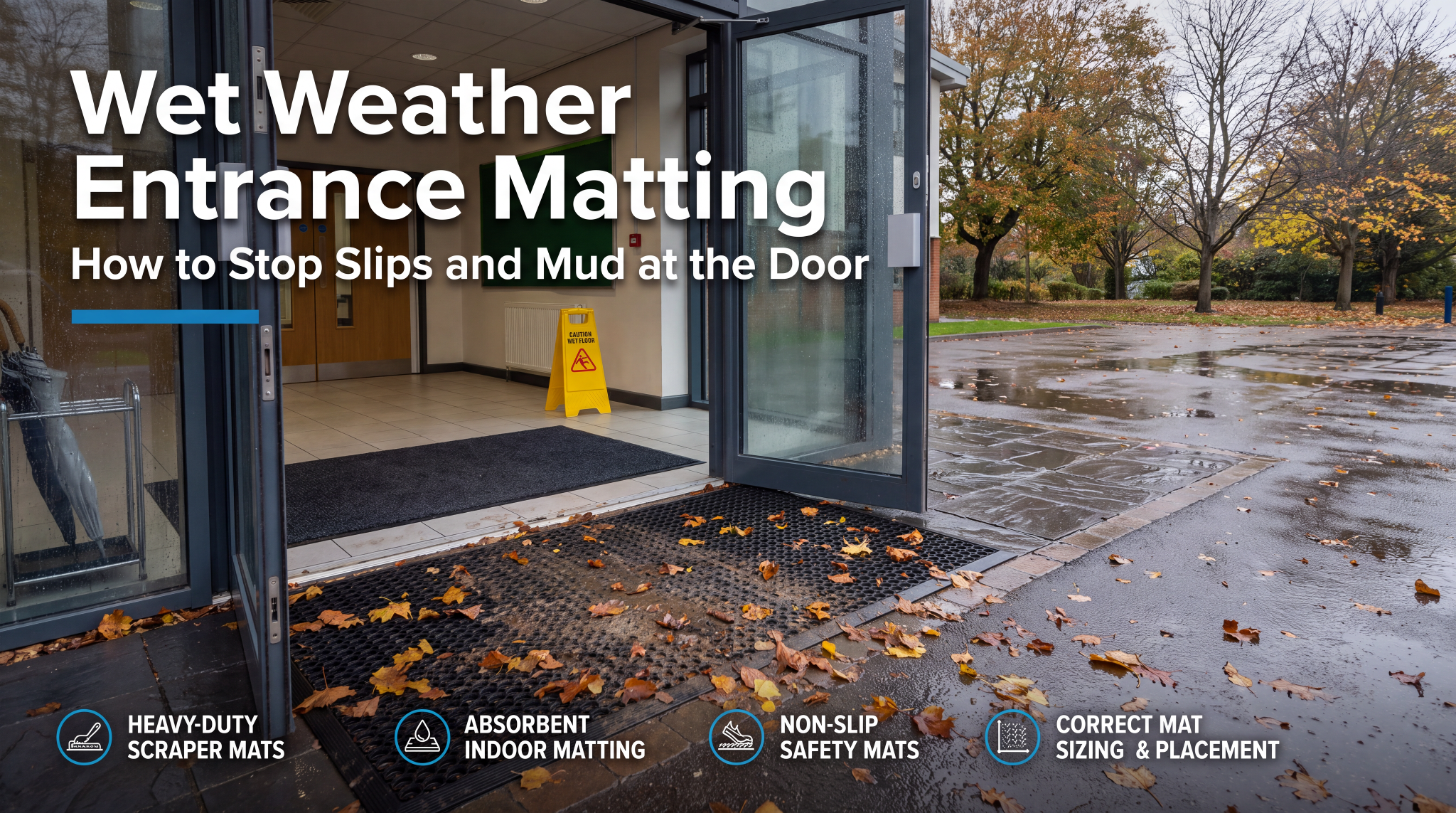
Every autumn the same thing happens. The first week of proper rain arrives. The entrance of every school and office turns into a skating rink of wet footprints and mud. Staff start mopping at 8.30am, and the floor is wet again by 8.45am. Wet weather entrance matting is the cheapest and most effective way to break that cycle. It stops the water and dirt at the door, before either can spread through the building.
This guide explains how entrance matting works, how to choose and place it, and how to build a simple wet weather routine around it. We wrote it for facilities managers, caretakers and school business managers who want dry floors and fewer incidents this winter.
Why wet entrances cause so many problems
Slips are one of the most common causes of injury in schools and workplaces. A wet entrance is where many of them start. Rain on shoes turns smooth floor tiles into a slip risk within a few steps. Pupils arriving in a crowd, carrying bags and coats, find it harder still to watch their footing.
The mess does not stay at the door either. Mud and grit travel down corridors on hundreds of soles. Every footprint adds to the daily cleaning workload. Grit also wears at floor finishes. A hard floor that would last for years in dry conditions loses its polish much faster under wet grit.
There is a legal side to this too. The Workplace (Health, Safety and Welfare) Regulations 1992 require employers to keep floors in a condition that does not put people at risk. A visible plan for wet entrances shows you take that duty seriously.
How entrance matting actually works
A mat does three jobs, and it helps to think of them separately. First, it scrapes the worst of the mud and grit off the sole. Second, it absorbs the water that shoes carry in. Third, it holds both until you clear them away, so they go no further.
A mat that does only one of these jobs falls short. A thin mat that scrapes but does not absorb leaves puddles around the edges. By contrast, a very absorbent mat with no scraping surface lets grit through to the floor. The best results come from the right mat in the right zone. The mat also needs enough length for people to use it properly.
Choosing the right mat for your entrance
Start with size, because it is the most common mistake. A small mat in front of a door gets stepped over, not walked across. Each foot needs to land on the mat several times for it to do its job. A busy main entrance needs a much longer run than a side door that a handful of staff use.
Next, think about footfall. A school entrance at drop-off sees hundreds of people in twenty minutes. An office reception sees a steadier flow across the day. Size the mat for the peak. A mat sized for the quiet periods will be overwhelmed at the busiest time.
Edges matter more than most buyers expect. A mat with curling or lifting edges is a trip hazard in its own right. Look for a flat, stable design with a backing that grips the floor. This matters most in schools and nurseries, where pushchairs and small children cross the mat every day.
Finally, think about how you will clean it. A mat you can lift, shake out and wash or replace easily will get looked after. A mat that is awkward to move tends to get ignored until it is saturated and no longer working. Express lists commercial floor mats within its Floorcare range. Check the current mat types and sizes against these points before you order.
Where to place your mats
The best layout uses more than one mat. A scraper mat outside the door removes the heaviest mud before anyone steps indoors. A second, more absorbent mat just inside takes the moisture that is left. Where the lobby is long enough, a third mat extends the dry zone further into the building.
Line each mat up with the way people actually walk. Check where the door swings, so the mat does not catch the bottom of the door. Make sure it does not block a fire exit or an accessible route. Then walk through the entrance yourself at the busiest time and watch where feet land. That tells you more than any floor plan.
Do not forget the secondary entrances. The playground door, the staff entrance and the door nearest the car park all bring in wet weather too. Fewer people use them, so they are easy to overlook. They are often where the worst mud arrives.
Add signs for the hours when the floor is wet
Even the best mat cannot dry every shoe. During heavy rain, the area just past the mat will still get wet now and then. That is when a warning sign matters. Wet floor signs, slip hazard signs and warning cones all belong in a wet weather kit. Express stocks each of these in its Floor Signs range.
Put signs out before the floor gets wet, not after someone has slipped. Take them away once the floor is dry. A sign left out all day stops being noticed. People learn to ignore it, so it protects nobody when it really matters. Keep a set of signs at each main entrance, so staff do not have to fetch them from a store.
Keeping the rest of the floor dry
Matting reduces the problem but does not remove it, so you also need the right tools for the clean-up. A good kit at each entrance includes a mop, a bucket and wringer, and a squeegee. The squeegee pushes standing water towards a drain or a door. Express carries mop heads in hygiene, microfibre and traditional styles. It also stocks buckets and wringers and floor squeegees and scrapers, so you can build the kit from one supplier.
Microfibre mop heads are popular for wet entrances because they pick up water quickly. Traditional heads still have a place on rougher floors. Whichever you use, rinse and wring them often. A saturated mop simply moves dirty water around, and the floor ends up wetter than when you started.
For larger entrance halls and corridors, a wet and dry vacuum or a scrubber dryer saves a great deal of time. Express lists both from brands including Numatic, Nilfisk and Kärcher. A machine lifts the water in a single pass, so the floor is safe again almost straight away. Where mud is the main problem, a floor sweeper clears the loose grit before it gets ground into the surface.
A simple wet weather routine
A routine works better than good intentions. Before the building opens, put out signs and check that each mat is flat and in position. If the forecast is bad, lay a spare set of mats. During the morning rush, assign one person to the main entrance with a mop and squeegee. They clear water as it arrives, not after it has spread.
Check the entrances again after break and lunch, when people come in from the playground or the car park. In heavy rain, check every hour. At the end of the day, lift the mats and shake out the loose dirt. Clear any standing water before you lock up. A mat left saturated overnight starts the next day unable to absorb anything.
A spare set of mats makes this routine much easier to keep up. When one set is saturated, swap it for a dry set and let the wet one dry out properly. Without a spare, a soaked mat stays in place and simply spreads water around the entrance.
Looking after your mats
A mat only works while it is clean and dry enough to absorb. Shake out or vacuum loose grit daily during wet weather. Clean mats according to the manufacturer's instructions. Check the edges and backing regularly. A mat that has started to curl or slide is a trip hazard, and it needs replacing, not repairing.
Replace any mat that is worn through, stained beyond cleaning, or no longer lying flat. A tired mat gives a false sense of security. It looks like protection but no longer does the job. A record of when each mat was fitted makes it easy to plan replacements before the worst of the winter weather arrives.
Common mistakes to avoid
A few mistakes come up again and again. Buying one small mat for a busy door is the first. Forgetting the side and staff entrances is another. Some sites leave wet floor signs out all day until nobody notices them. Others let saturated mats stay down because nobody has time to swap them. All four are easy to fix with a little planning, and they cost far more in incidents and cleaning time than the planning would.
Ordering ahead is the final piece. Mats, signs and mop heads are much easier to get in early October than in the first week of heavy rain, when every site orders at once. A short check of what you have now, and what you need before the weather turns, saves you from scrambling later.
Frequently Asked Questions
How long should entrance matting be?
Long enough that each foot lands on the mat several times as someone walks across it. A busy main entrance needs a much longer run than a side door, so size each mat to the footfall it will see.
Do I need mats inside and outside the door?
Using both works best. A scraper mat outside removes the heaviest mud. An absorbent mat inside takes the remaining moisture, so the floor beyond stays dry for longer.
When should wet floor signs go out?
Before the floor gets wet, they should come away once it is dry. Signs left out all day get ignored, so they stop protecting anyone when a real hazard appears.
How often should entrance mats be cleaned in wet weather?
Shake out or vacuum them daily, and swap or wash them as soon as they are saturated. A mat that cannot absorb any more water is no longer protecting the floor.
Are wet entrances really a legal issue?
Employers must keep floors in a safe condition under the Workplace (Health, Safety and Welfare) Regulations 1992. A clear wet weather plan, with mats, signs and a cleaning routine, is a sensible way to show you are meeting that duty.