



Hard floors in schools and commercial buildings rarely fail all at once. They slowly lose their finish through foot traffic, trolley routes, grit, spillages and daily cleaning that does not quite keep pace with use. By the time corridors look dull or entrances start to show traffic lanes, the surface usually needs more than a quick mop.
That is where Twister floor pads can be useful. These diamond floor pads are designed to clean and mechanically polish hard floors while reducing reliance on daily floor cleaning chemicals. At Express Cleaning Supplies, we see them as a practical option for facilities teams that want a simpler, lower chemical approach to floor maintenance without changing the whole cleaning process.
What are Twister floor pads?
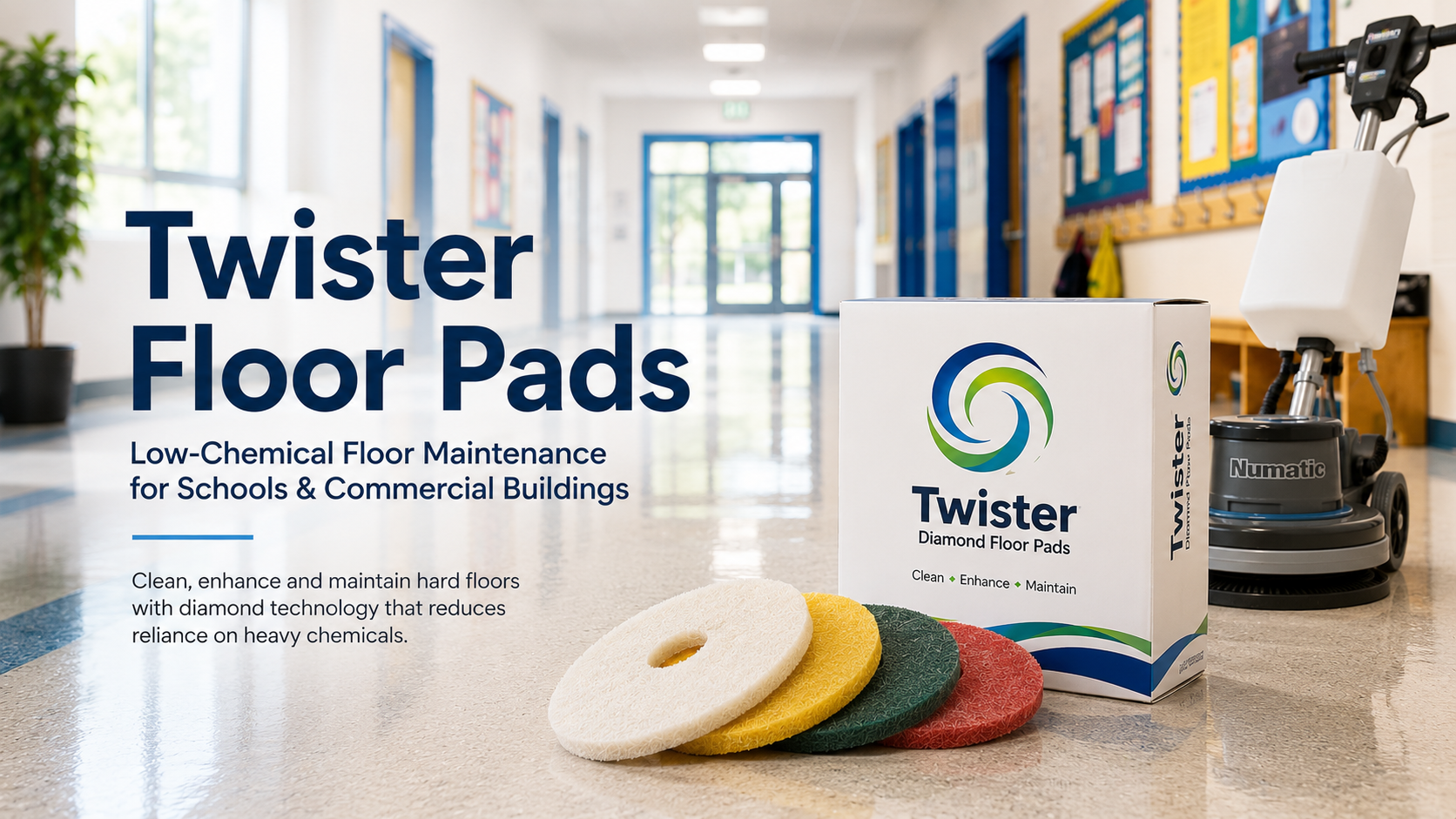
Twister floor pads are diamond impregnated cleaning pads developed for hard floor cleaning and maintenance. Instead of depending mainly on detergent, wax or floor polish, the pad uses microscopic diamonds to clean and refine the floor surface as it moves across it.
In practice, this means the pad helps remove soil and very fine scratches while improving the smoothness and appearance of the floor. As a result, facilities teams can maintain a cleaner, glossier finish with less chemical input during routine cleaning.
They are not a magic replacement for every floorcare product. However, they can reduce the amount of daily chemicals used on suitable floors, especially where the main issue is dullness, micro scratching and general traffic wear rather than heavy grease or contamination.
Why low chemical floor cleaning matters
Low chemical floor cleaning is not only about sustainability. It also affects cost control, storage, training and day-to-day cleaning consistency.
Every chemical product in a school or workplace needs correct storage, dilution, handling and staff understanding. HSE COSHH guidance for cleaning tasks highlights safe storage, good working techniques, suitable PPE where needed and proper ventilation. Therefore, any system that reduces unnecessary chemical use can make the cleaning cupboard easier to manage, provided it still cleans effectively.
For schools, this can be especially useful during term time. Site teams often clean corridors, halls and classrooms in narrow windows, so reducing product changes, measuring and rinsing steps can save time. Meanwhile, commercial facilities may benefit from lower product usage across large hard floor areas.
At the same time, low chemicals do not mean no control. Staff still need to clean pads, maintain machines, manage wet floors safely and use specialist chemicals where they are genuinely required.
How Twister floor pads work
Mechanical cleaning and polishing
The diamond material in Twister floor pads works through controlled mechanical action. As the machine moves, the pad gently abrades and refines the surface. This helps remove dirt and micro scratches, leaving a smoother finish.
That mechanical action is why these pads can be used with water in many daily maintenance routines. It also explains why they are different from standard floor maintenance pads, which often rely more heavily on chemical support or existing polish systems.
Express Cleaning Supplies lists Twister pads as suitable for chemical free floor cleaning and maintenance, with compatibility across rotary machines and drive-board compatible scrubber dryers. The range supports use across surfaces such as stone, vinyl, linoleum and industrial concrete.
The colour-coded system
Twister floor pads use a colour-coded system so cleaners can match the pad to the condition of the floor and the result needed. This is important because an aggressive pad used in the wrong place can create unnecessary surface damage, while a maintenance pad used too early may not remove enough wear.
The 17 inch Twister floor pad page explains that the range supports both standard and intensive methods. For example, White Step 1 helps remove tiny scratches and leaves a silky matt surface ready for the next stage, while Yellow Step 2 further prepares the floor for finishing. For tougher work, Black targets stained industrial concrete, and Red is designed for heavy duty cleaning of industrial coatings and heavily worn stone floors.
For this reason, facilities teams should treat the colour system as part of the method, not decoration. The right pad sequence matters.
Where Twister floor pads make sense
Twister floor pads are most useful where a hard floor needs regular maintenance rather than emergency rescue. They suit buildings where appearance matters, but where teams want to avoid constant chemical polishing or repeated heavy treatment.
In schools, they can work well in:
- Corridors with visible traffic lanes
- Dining hall routes after routine soil removal
- Reception areas and main entrances
- Assembly halls and multi-use spaces
- Staff areas and offices with hard floors
- Wider circulation routes cleaned by machine
In commercial buildings, they can support reception areas, offices, retail floors, healthcare corridors, leisure centres and public spaces with suitable hard flooring.
However, they should not be chosen only because the floor looks tired. First, check the floor type, coating condition and level of contamination. If the floor has heavy polish build-up, deep staining, grease or structural damage, it may need stripping, degreasing, repair or specialist treatment before Twister pads can maintain it properly.
Which machines can use Twister floor pads?
One reason Twister floor pads are practical is that they work with existing equipment in many facilities. Express lists them as compatible with all rotary machines and drive-board compatible scrubber dryers.
This matters for schools and commercial sites because most teams do not want to replace machines just to change floor pads. If the existing rotary or scrubber dryer uses a compatible drive board and correct pad size, Twister pads can often fit into the current workflow.
Express Cleaning Supplies stocks multiple Twister floor pad sizes, including 13 inch, 14 inch, 15 inch, 16 inch, 17 inch and 20 inch options. This gives facilities teams flexibility across smaller machines, standard rotary machines and larger scrubber dryer setups.
For compact scrubber dryers, Express also lists 220mm diamond Twister style pads for Numatic NCC 220NX and NCC 440NX machines, designed to deep clean and mechanically polish hard floors using just water.
How to introduce Twister pads into a floorcare routine
Start with a floor assessment
Before switching pads, inspect the floor properly. Look for old polish build-up, dull traffic lanes, scratches, staining, ingrained soil, loose edges and areas that become slippery when wet.
This assessment tells you whether the floor is ready for maintenance or needs restoration first. In practice, Twister pads work best when the floor is structurally sound and the chosen pad matches the current condition.
Remove dry soil first
Always sweep, dust mop or vacuum before using a machine. Grit and loose soil can scratch the floor if dragged under a pad. This step is simple, but it makes a major difference to the final finish.
For schools, entrances and corridors usually need extra attention because outdoor grit travels quickly through the building. Meanwhile, offices and reception areas may collect fine dust that dulls the floor over time.
Use the right pad and enough water
Follow the pad method carefully. Use the correct colour for the floor condition and move through the sequence where required.
In daily maintenance, many Twister systems can work with water rather than daily detergent. However, that does not remove the need for clean water, correct machine setup and steady passes. Too little water can reduce performance, while poor recovery can leave residue or moisture behind.
Safety and drying time still matter
Even when chemical use is reduced, floor cleaning can still create slip risk. HSE guidance advises cleaning during quiet hours where possible, cleaning in sections, leaving smooth floors dry after cleaning or excluding pedestrians until the floor is dry. It also reminds teams to remove warning signs once the floor is clean and dry.
This matters in schools because holiday clubs, contractors and staff may still move through the site. It also matters in commercial buildings where cleaning happens during opening hours.
Twister pads may reduce chemical complexity, but facilities teams still need a safe system of work. That includes machine checks, wet floor signage, access control, drying time and staff training.
Benefits for schools and commercial buildings
Lower chemical usage
The main benefit is reduced reliance on daily floor cleaning chemicals for suitable maintenance tasks. As a result, schools and facilities teams can reduce chemical handling, simplify stock control and support sustainability goals.
This can be particularly helpful where multiple staff members use the same cleaning store. Fewer daily chemicals usually mean fewer dilution errors and fewer product compatibility issues.
Better consistency
Because Twister pads are used as part of a machine process, they can create more consistent results than ad hoc mopping or overuse of polish maintainer. The method is repeatable, which helps large sites standardise across different zones.
Improved appearance over time
Twister pads are designed to refine the surface as part of maintenance. Therefore, floors can gradually regain a cleaner, glossier appearance when the correct sequence is followed.
That said, expectations should stay realistic. A heavily damaged floor will not become new after one pass. The best results usually come from a planned method, correct pad choice and regular maintenance.
Common mistakes to avoid
The first mistake is treating Twister pads as a quick fix for every floor. If the surface has deep damage, failed polish or heavy contamination, the right answer may be stripping, deep cleaning or repair first.
The second mistake is choosing the wrong pad colour. Too aggressive, and you may mark a surface unnecessarily. Too mild, and you may waste time without improving the finish.
The third mistake is skipping dry soil removal. Grit under a pad can undermine the whole process.
The fourth mistake is ignoring machine conditions. A dirty tank, worn drive board or uneven pad pressure can affect the result.
Finally, do not assume low chemical means low training. Staff still need to understand the pad system, machine operation, drying time and safe access control.
Buying checklist for Twister floor pads
Before ordering Twister floor pads, check:
- The floor type and current condition
- Whether the floor needs restoration or routine maintenance
- The machine type, rotary or scrubber dryer
- The required pad size, such as 13 inch, 15 inch, 17 inch or 20 inch
- Whether the machine uses a compatible drive board
- The correct pad colour and method for the task
- Water recovery and drying arrangements
- Staff training and safe working procedures
- Replacement pad stock for ongoing maintenance
At Express Cleaning Supplies, we always recommend buying floor pads as part of a complete floorcare method. The pad, machine, operator, water control and cleaning schedule all need to work together.
FAQs
What are Twister floor pads?
Twister floor pads are diamond impregnated commercial floor pads that clean and mechanically polish suitable hard floors. They use microscopic diamonds to remove dirt and fine scratches while helping improve surface appearance.
Do Twister floor pads remove the need for chemicals?
They can reduce the need for daily floor cleaning chemicals on suitable floors. However, facilities teams may still need specialist chemicals for grease, stripping, disinfection, heavy staining or periodic deep cleaning.
Can schools use Twister floor pads?
Yes, they can be suitable for school corridors, halls, dining routes and other hard floor areas where a machine is already used. Schools should still check floor type, pad size, access control and drying time.
Are Twister pads compatible with scrubber dryers?
Yes, Express lists Twister pads as compatible with rotary machines and drive-board compatible scrubber dryers. The range is available in several sizes to suit different equipment setups.
What floors can use diamond floor pads?
Twister pads can support maintenance on hard floors such as stone, vinyl, linoleum and industrial concrete. However, the correct pad and method should be chosen for the specific surface.
Are Twister pads suitable for heavily damaged floors?
Sometimes, but only as part of the right restoration method. Heavily worn stone, stained industrial concrete or damaged coatings may need more intensive pad stages or other preparation before routine maintenance.
At Express Cleaning Supplies, we see Twister floor pads as a practical way for schools and commercial buildings to simplify hard floor maintenance. Used correctly, they can support low chemical floor cleaning, improve day-to-day presentation and help facilities teams keep busy floors looking professional with a more controlled, repeatable process.