



School drain odours tend to show up at the worst time. The building is quieter, the weather is warmer, and the site team is trying to prepare washrooms, kitchens, changing rooms and classrooms before September. Then a smell starts coming from a sink, shower outlet, floor gully or washroom drain.
In most cases, smelly drains in schools are not caused by one sudden failure. They usually come from a build-up of organic residue, soap deposits, grease, stagnant water or slow-flowing pipework. Summer can make the problem more noticeable because warmth encourages odour, and reduced water use during the holidays can allow traps and outlets to dry or stagnate.
At Express Cleaning Supplies, we treat drain odour control as a maintenance routine, not just an emergency response. Our drain cleaner range includes maintenance products, biotech solutions, sink plungers and stronger unblockers for more serious problems, so schools can match the product to the level of risk and urgency. The category covers products designed for sinks, showers, floor drains, odours, grease, hair, soap residue and organic matter.
Why school drains smell more in summer
Summer creates a particular set of drain problems. Washrooms may be used less often, but they still contain residues from term time. Kitchen sinks may be cleaned after final catering service, then left with small amounts of food waste and grease in the pipework. Meanwhile, shower drains in sports areas and nurseries can hold soap residue, hair and organic matter.
As a result, odours often become stronger when the building is warm and airflow is limited. If water in traps evaporates, smells from pipework can travel back into the room. Similarly, if a drain is slow but not fully blocked, staff may not notice the problem until the smell becomes obvious.
This is why a school drain cleaner should not only be kept for emergencies. Preventive maintenance before and during the holidays usually costs less than dealing with blocked school drains once staff and pupils return.
Where drain odours usually start
Washroom basins and floor gullies
Pupil washrooms are high-use spaces. Soap, toothpaste residue, hand towel fibres, hair and general grime can sit inside outlets. Over time, that build-up can create odours even if the water still drains.
Floor gullies need particular attention because they often get cleaned around rather than cleaned through. If they dry out during holiday closure, they can become a source of unpleasant smell before anyone spots a visible blockage.
Kitchen sinks and food prep areas
School kitchens and staff kitchens create different risks. Food residue, fats, oils and grease can line pipework. In warm weather, even a small amount of organic residue can generate a noticeable odour.
For this reason, commercial kitchen drains need a routine maintenance product, not just a reactive unblocker. Products such as Christeyns Clover Zi-Gest Drain Maintainer are designed to digest oils, fats, grease, protein, starch and organic matter, and the product page specifically notes that it biologically breaks down causes of bad odours and blockages.
Shower drains and changing areas
Sports changing areas, nursery washing points and shower drains often hold hair, soap and body fats. These are not always serious blockages, but they can slow flow and cause odours.
A biotech or enzyme-style maintenance product can be useful here because the aim is ongoing digestion of organic residues, not harsh emergency treatment every time.
Maintenance drain cleaners vs emergency unblockers
Not every commercial drain cleaner does the same job. Some products are designed for routine maintenance and odour control, while others are designed to tackle more urgent blockages.
Biotech and enzyme drain cleaners
For regular use, we generally recommend starting with a maintenance-style product. These are better suited to school holidays because they support ongoing drain hygiene without treating every outlet as an emergency.
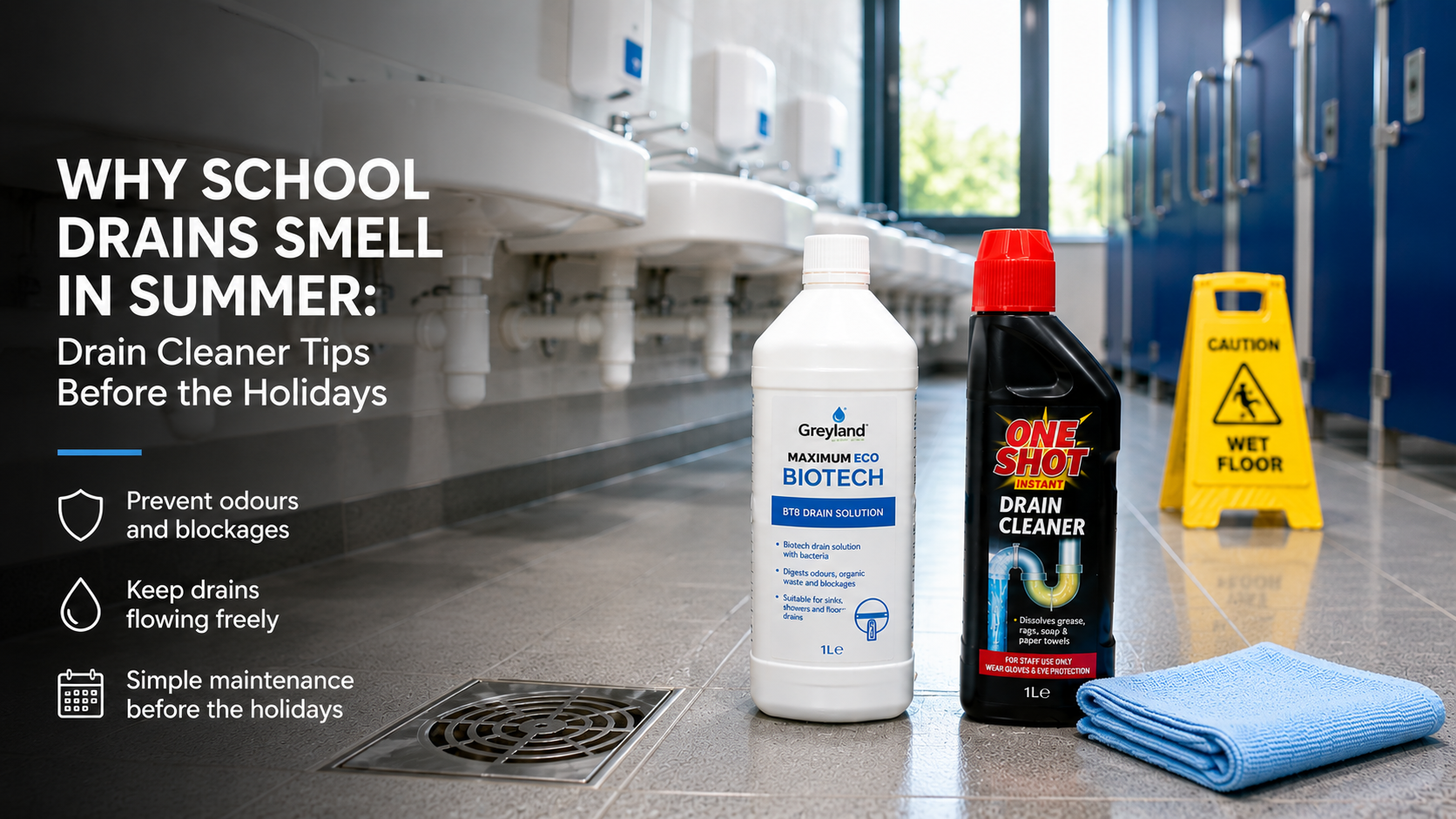
Greyland Maximum Eco Biotech BT8 Drain Solution is a strong example. Express lists it as a biotech drain solution with bacteria that digest odours, organic waste and blockages. It is suitable for sinks, baths, showers, kitchen units, septic tanks and sewage treatment systems, and the product guidance describes use with warm water and a minimum contact time, ideally overnight where possible.
Products like this make sense for summer maintenance rounds. They support odour prevention and help improve flow rates in small-bore pipework.
Stronger unblockers
Sometimes a drain is not just smelly. It is blocked, backing up or draining too slowly for normal site operation. In those cases, a heavier unblocker may be required.
One Shot Instant Drain Cleaner is stocked by Express as a stronger drain clearing product. The product page states that it dissolves grease, rags, soap and paper towels, but it also makes clear that sales are legally restricted, and that PPE such as eye goggles and gloves is required.
This kind of product should not be treated as a casual daily cleaner. In schools, it should sit behind a controlled process with trained staff, secure storage and clear escalation rules.
A summer drain maintenance routine for schools
A simple routine usually works better than waiting for complaints. Before the summer closure, site teams should inspect every washroom, kitchen and wet area. Then they should prioritise outlets that have slow flow, visible build-up or previous odour complaints.
A practical routine might look like this:
- Flush little-used outlets with water before applying treatment.
- Remove visible debris from plug holes and floor gullies.
- Use a maintenance drain cleaner in sinks, showers and kitchen outlets.
- Leave biotech products to work for the recommended contact time.
- Record drains that remain slow after treatment.
- Escalate repeated problems to estates or a drainage contractor.
- Repeat treatment before the building fully reopens.
This gives schools a record of what has been treated and where problems are recurring.
Safety and storage matter
Drain cleaners can involve stronger chemistry than many daily cleaning products. Therefore, schools should not store or use them casually.
HSE guidance on cleaning chemicals highlights safe storage, good working techniques, suitable PPE where needed, hand care and ventilation. For schools, this also means keeping products securely away from pupils and making sure staff can access product instructions and Safety Data Sheets.
In practice, stronger drain unblockers should be handled by trained adults only. Staff should never mix drain cleaners with bleach, descalers or other chemicals. They should also avoid using strong products where another chemical may already be present in the drain.
When to escalate beyond drain cleaners
A school drain cleaner is not the answer to every drain problem. If water backs up repeatedly, multiple drains smell at once, or the same outlet blocks again after treatment, the issue may sit deeper in the system.
Escalate when:
- Several drains in one block smell at the same time.
- Water backs up through floor gullies.
- A drain remains slow after maintenance treatment.
- Odour returns quickly after cleaning.
- There is suspected pipe damage or external drainage failure.
- Staff are unsure which chemicals have already been used.
At that point, a maintenance contractor or drainage specialist may be needed. Using stronger chemicals again and again can create safety risks without solving the underlying issue.
Drain maintenance checklist before September
Before pupils return, check:
- Washroom basins and sink outlets
- Urinals and nearby floor gullies
- Shower drains in sports or nursery areas
- Kitchen sinks and grease-prone outlets
- Staff room sinks
- Science prep sinks where suitable
- Cleaner cupboard sinks
- External drains near dining or playground areas
- Any drain with a history of odour or slow flow
For each area, record whether the drain flows freely, smells clean and has been treated. This helps schools move from reactive cleaning to planned drain odour control.
FAQs
Why do school drains smell in summer?
Warm weather, reduced water flow, dry traps and old organic residue can all make school drains smell stronger during summer holidays. Sinks, showers, kitchens and floor gullies are common sources.
What is the best drain cleaner for school odours?
For routine odour control, a biotech or enzyme-style drain maintainer is usually the best starting point. Greyland Maximum Eco Biotech BT8 and Christeyns Zi-Gest are relevant options within the Express range.
Should schools use strong drain unblockers?
Only when the issue is a real blockage and staff have the correct training, PPE and storage controls. Stronger unblockers should not replace routine maintenance.
How often should schools treat drains?
High-risk outlets may need treatment before holidays, during closure and before reopening. Kitchens, showers and washroom gullies usually need more attention than low-use staff sinks.
When should blocked school drains be referred to maintenance?
If a drain repeatedly blocks, backs up, smells after treatment or affects multiple outlets, escalate the issue. Repeated chemical use is not a substitute for fixing a drainage fault.
At Express Cleaning Supplies, we help schools choose drain cleaners by task, not guesswork. Used properly, the right product can keep drains fresher, reduce disruption and help site teams avoid unpleasant surprises before September.