




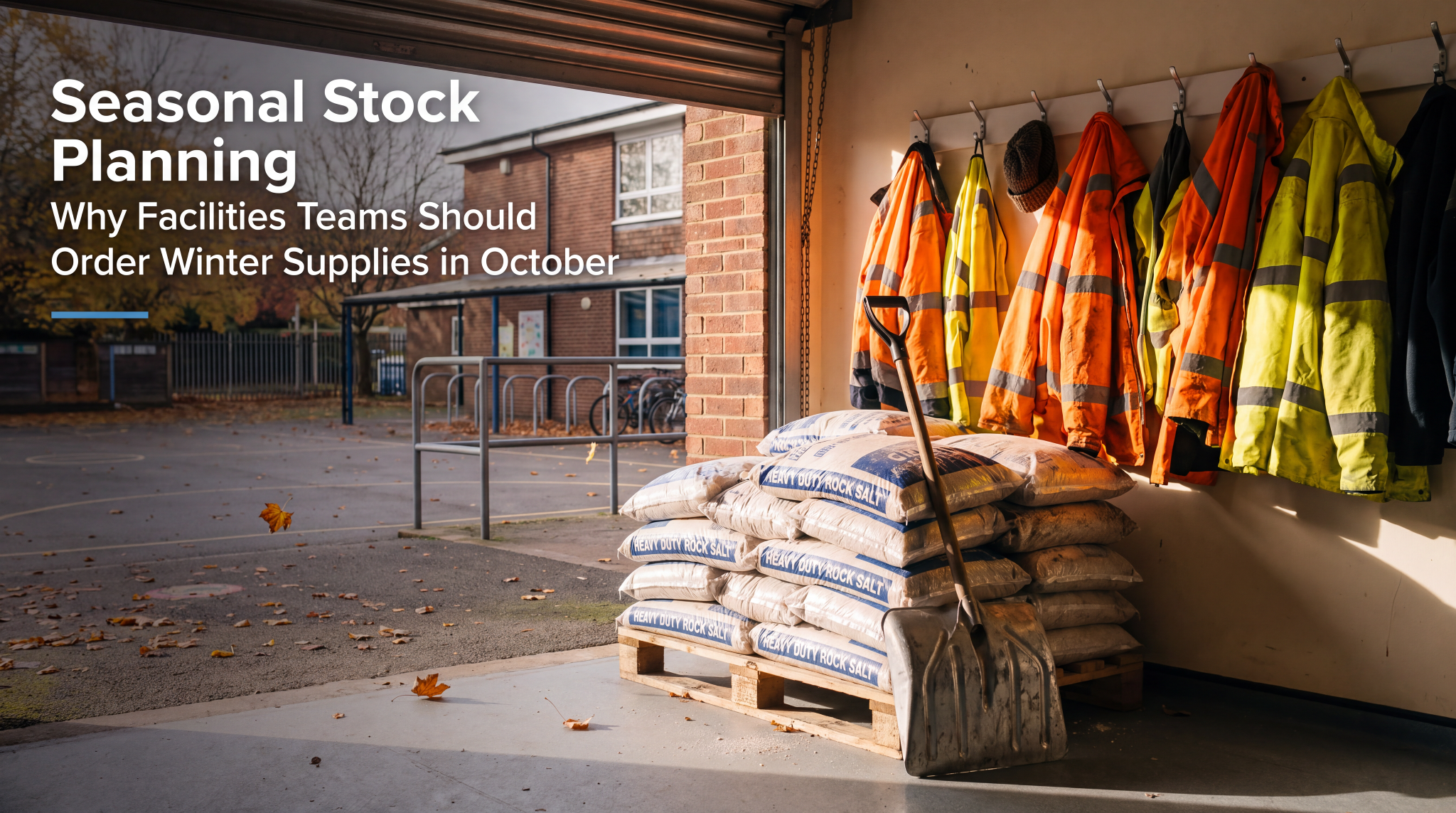
Winter stock planning is one of those jobs that is easy to postpone until the weather forces the issue, and by then it is already too late to plan properly. Facilities teams that treat October as the natural ordering point, rather than reacting to the first cold snap, consistently end up better prepared and better positioned on price and delivery than those placing the same order once everyone else already has.
This guide looks at why October is the right time to plan, what actually drives the demand curve through autumn and winter, and how to build a planning process that does not rely on remembering to think about it each year.
The planning problem with winter stock
Winter supplies like salt, outerwear for outdoor staff and site clearance equipment are needed suddenly and used predictably once conditions turn, but ordering tends to happen reactively rather than on a planned schedule. A facilities team that waits until the first properly cold morning to think about salt stock is making a purchasing decision under pressure, with less choice and less control over timing than a team that planned the same order weeks earlier.
This is a planning problem more than a stock problem. The supplies themselves are not complicated to source, but ordering them at the wrong point in the season creates avoidable pressure that a small amount of forward planning removes entirely.
Why demand spikes sharply once the weather turns
Winter supply demand is not evenly spread across the colder months. It is concentrated into a short, sharp spike that begins the moment the first cold snap hits, as every school, nursery and care setting in the area places broadly the same order within the same few days. Suppliers see this pattern every single year, and lead times lengthen accordingly once that spike begins.
Ordering in October, while demand is still spread out and manageable, means a facilities team is working with normal lead times rather than competing for limited stock and slower delivery windows during the exact week supplies are needed most urgently.
What a winter stock plan should actually cover
Salt and site clearance equipment sit at the centre of most winter stock plans, and getting the quantity right depends on mapping the actual site rather than ordering a standard amount. Every entrance, car park and pedestrian route that needs treating during a cold spell should be accounted for individually, since a single central store of salt rarely reaches every point on a larger site quickly enough during an actual cold snap.
Outerwear for staff working outside through the colder months is just as much a planning item as salt itself, even though it gets overlooked more easily. Staff responsible for early morning site checks, gritting, or general outdoor duties need properly warm, weatherproof clothing provided ahead of the season, not sourced reactively once someone is already standing outside in genuinely cold conditions without it.
Shovels and general clearance equipment round out the core list. A site with salt but no way to clear heavier snowfall first is only partially prepared, and checking that existing equipment from previous years is still in usable condition, rather than assuming it survived storage well, avoids discovering a gap on the morning it is actually needed.
Building a planning process rather than relying on memory
A written seasonal stock plan, reviewed at the same point every year, removes the reliance on someone remembering to think about winter supplies before the weather turns. October is a sensible fixed point to build this review around, since it gives enough lead time to place an order and receive it well before demand across the sector picks up.
This matters particularly where responsibility for ordering shifts between staff members from year to year. A documented plan gives a new starter or a colleague covering the role something concrete to follow, rather than relying on an informal sense of what the site typically needs that only exists in one person's head.
Reviewing actual usage rather than repeating last year's order
The most useful input into a winter stock plan is not a generic quantity but a genuine review of how much was actually used the previous winter, and whether that was enough. A site that ran low on salt partway through last winter should be ordering more this year, not repeating the same figure and hoping for a milder season. Building in a reasonable buffer above last year's usage, rather than ordering to the exact figure, protects against a colder or longer winter than the one being planned around.
Factoring in supplier lead times from the outset
Lead times are not fixed throughout the year, and a plan built around normal autumn lead times can be caught out if it assumes those same timeframes will still apply once demand across the sector increases. Checking expected delivery times at the point of ordering, rather than assuming a standard turnaround, gives a facilities team a more realistic picture of when stock will actually arrive.
This is particularly worth factoring in for any order of a larger quantity or a product not ordered regularly throughout the year, since an unfamiliar or larger order sometimes takes longer to fulfil than a routine reorder of something already stocked.
Storage considerations for winter stock
Where winter stock is kept matters almost as much as how much of it there is. Salt left exposed to damp can clump and become difficult to spread evenly, which undermines exactly the reliability a facilities team is planning for in the first place. Proper covered storage, rather than open bags in a general store, keeps salt usable throughout the season rather than degrading partway through winter.
Outerwear and clearance equipment benefit from being stored somewhere accessible to whoever carries out early morning site checks, rather than in a central store that requires a separate trip to reach. A site where winter kit is kept close to where it is actually needed on a frosty morning gets used consistently, while kit stored further away is more likely to be skipped on the mornings it matters most.
Building flexibility into the plan for an unusually severe winter
A good winter stock plan accounts for an average season, but it is worth building in some flexibility for a winter that turns out to be more severe than usual. Knowing in advance which supplier can fulfil a smaller top-up order quickly if conditions are worse than expected, rather than only having a plan for the initial October order, gives a facilities team a genuine fallback rather than being caught out entirely by an unusually harsh spell.
This does not mean over-ordering every year on the assumption of a bad winter. It means knowing the plan for a top-up before it is needed, so that if conditions do turn out to be worse than planned for, the response is a quick, pre-agreed order rather than a scramble to find available stock at short notice.
Aligning the order with site-specific risk areas
A generic winter stock order rarely accounts for the particular layout of a given site, and two schools of similar size can have very different winter risk profiles depending on how exposed their entrances and pathways are. A site with a long, sloped approach or an exposed car park needs a different quantity and distribution of salt than a smaller, more sheltered site, even if both have a similar overall footprint.
Walking the site specifically with winter risk in mind, rather than relying on a general sense of the building, helps identify the points that genuinely need prioritising when stock is limited or a delivery is delayed. This kind of site-specific review tends to produce a far more useful plan than applying the same standard quantity regardless of layout.
FAQ
Why does October work better than November for ordering winter stock? Demand is still spread out in October, before the first cold snap pushes every site in the area to order within the same short window, which keeps both availability and lead times more favourable.
What should a winter stock plan include beyond salt? Outerwear for outdoor staff and site clearance equipment like shovels are just as important as salt itself, even though they are more easily overlooked during planning.
Should winter stock quantities be based on last year's order or reviewed each year? Reviewed each year. Checking how much was actually used, and whether that was enough, gives a far more accurate figure than repeating the same order regardless of how the previous winter went.
Why do lead times get longer later in the season? Once the first cold snap arrives, demand spikes sharply across the whole sector at once, which stretches supplier capacity and lengthens delivery times compared with ordering earlier in the autumn.