



School waste is rarely a single-bin problem. A classroom produces paper, snack wrappers and pencil-sharpening waste. A dining hall creates food waste, packaging and spill-related rubbish. A playground collects litter in unpredictable places, especially after break, lunch and community lettings.
For this reason, school waste management needs more thought than buying larger bins and hoping they cope. The right combination of bins for schools, recycling bins for schools, bin liners for schools and litter-picking tools can make daily site management easier, support recycling compliance and improve the way a campus looks to pupils, staff, parents and visitors.
At Express Cleaning Supplies, we see the strongest results where schools build waste systems around real behaviour. That means putting the right bin in the right place, using clear colour coding, choosing liners that fit the waste stream and giving site teams practical tools for outdoor litter control.
Why school waste management is changing
Schools in England now need to think more carefully about waste separation. Government guidance says workplace recycling rules came into force on 31 March 2025, requiring workplaces to separate dry recyclable materials, food waste and non-recyclable waste before collection. Micro-firms have until 31 March 2027, but this will not usually apply to most schools.
Government school procurement guidance also states that all schools in England must comply with the new recycling regulations, with recycling and collection measures needed for food waste, glass, metal, plastic, paper and cardboard. It also notes that schools can use the same bin for dry mixed recycling and should have at least three waste containers for dry recyclables, food waste and non-recyclable waste.
However, compliance is only part of the story. In practice, recycling works when pupils and staff can make the right choice quickly. If a bin station is unclear, too far away or badly maintained, contamination rises and cleaners end up sorting problems after the fact.
Start with placement, not product
A good school waste system begins with a simple site walk. Do not start by counting bins. Start by looking at where waste actually appears.
Classrooms and offices
Classrooms need small, clear systems that support everyday behaviour. Paper recycling should be easy in rooms where worksheets, envelopes and exercise-book waste build up. Meanwhile, general waste still needs a home for tissues, wrappers and non-recyclable items.
In offices and reprographics areas, paper and card volumes are usually higher. Therefore, a clearly labelled recycling bin near printers and photocopiers often performs better than a general bin under every desk.
Corridors, dining halls and shared spaces
Corridors need durable bins that can handle peaks between lessons. Dining halls need more capacity, because waste arrives in short bursts. For example, a lunch period can overwhelm a small classroom-style bin within minutes.
In these areas, grouped recycling stations usually work better than isolated bins. Put general waste, dry mixed recycling and food waste together. As a result, pupils do not have to search for the right option.
Playgrounds and outdoor areas
Outdoor waste is different. Weather, distance and wind matter. Bins need lids, weight and enough capacity for breaktime. At the same time, site teams need litter pickers for schools and suitable sacks so they can manage loose litter without unnecessary bending or hand contact.
Choosing recycling bins for schools
Express Cleaning Supplies’ recycling bins range is designed for workplaces, schools and public environments, including colour-coded waste bins for clear separation of materials. The range includes indoor and outdoor options, with school recycling bins described as useful for classrooms, corridors and canteens.
For many schools, a modular approach works best. The Robert Scott Recycling Buddy Bin 60L with Open Lid is a practical example. It features coloured open lids to support waste segregation and can be used individually or linked as a set with a wheeled dolly.
That kind of system suits corridors, dining halls and shared learning areas where pupils need clear visual cues. In contrast, smaller recycling bins may suit classrooms and staff offices where volume is lower and appearance matters more.
Matching bins to waste streams
Dry mixed recycling
Dry mixed recycling usually includes paper, card, plastic, metal and glass, depending on the collection arrangement. Schools should confirm the exact rules with their waste contractor, because accepted materials can vary by collection service.
A clear lid colour and simple labelling will usually do more than a long poster. Pupils make decisions quickly. Therefore, the visual design needs to support fast, correct disposal.
Food waste
Food waste needs separate handling because odour and leakage become problems quickly. In dining halls, food caddies or larger food waste containers should sit close to tray return points, not hidden near the kitchen door.
Express Cleaning Supplies lists food waste products alongside recycling options, including the Robert Scott Food Caddy Waste Bin 23L as a related product on its recycling bin pages. For larger food waste routes, schools should pair the container with liners designed for organic waste collection.
General waste
General waste still matters, even when a school improves recycling. If the general waste bin is missing, pupils will contaminate recycling streams with tissues, dirty packaging and non-recyclable items.
For larger outdoor or service areas, wheelie bins make sense. The Bentley 240 Litre Wheelie Bin is suitable for commercial use, has rear wheels for manoeuvrability and conforms to EN840, which makes it a practical option for school waste holding areas.
Bin liners for schools, strength and fit matter
The cheapest liner is rarely the cheapest solution if it splits, leaks or does not fit the bin. Schools should match bin liners for schools to capacity, waste weight and removal route.
A lightweight liner can work well for dry classroom waste. However, food waste, playground litter and heavier rubbish need stronger sacks. Express Cleaning Supplies stocks black sacks, clear sacks, coloured sacks, wheelie bin liners and eco-friendly sack options, which gives schools a way to standardise by area rather than overbuy one type for everything.
Coloured sacks can also support segregation. Express describes coloured refuse sacks as useful for professional cleaning teams and facilities managers, with different colours helping separate waste streams such as general waste, recyclables, clinical waste and compostable materials.
Coloured sacks and colour coding
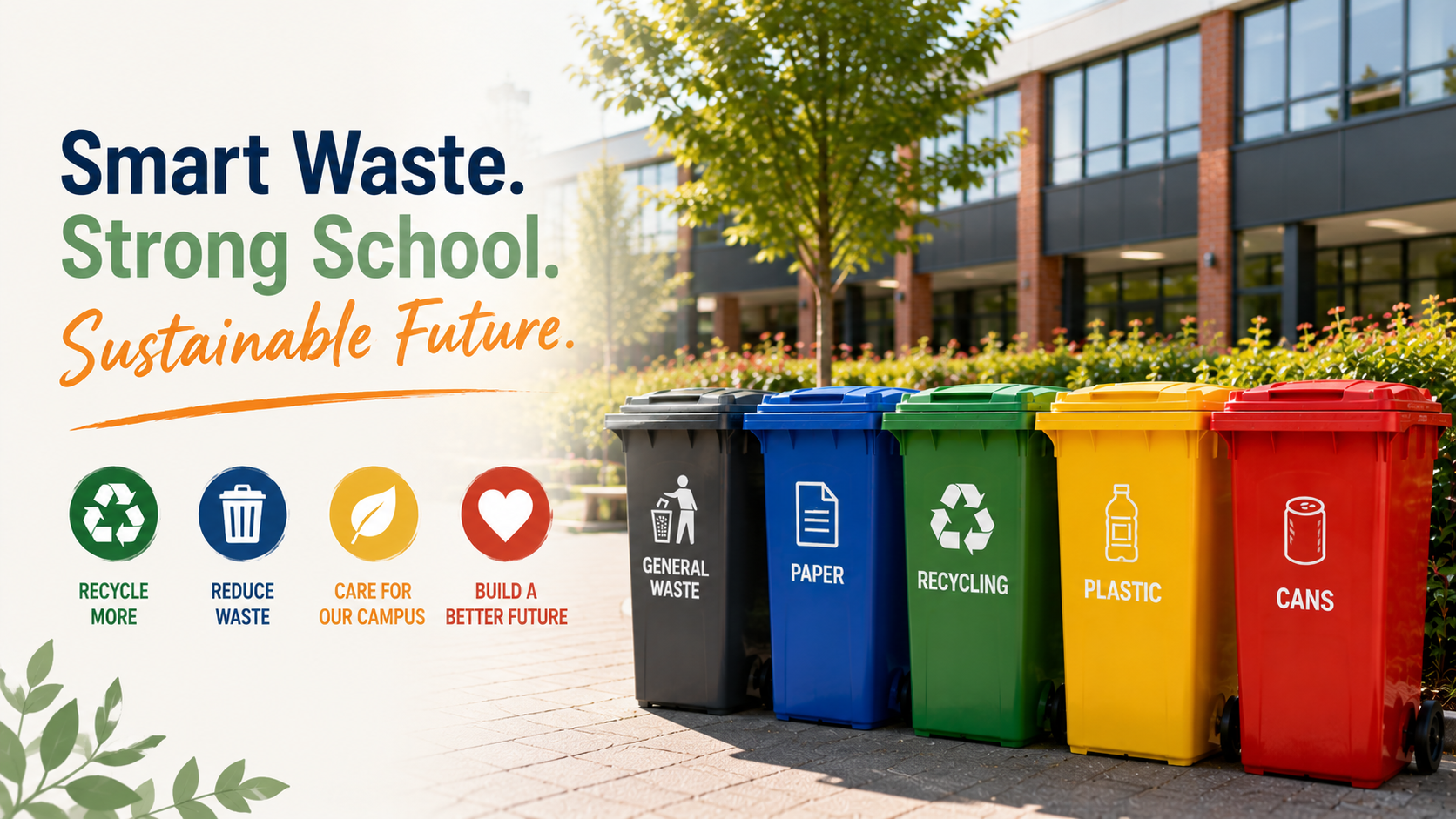
Colour coding works best when it stays simple. Too many colours create confusion, especially for younger pupils and visiting users.
A practical school system might use:
- Blue or clear sacks for dry mixed recycling
- Black sacks for general waste
- Brown or compostable liners for food waste
- Yellow or specialist sacks only where a defined waste stream requires them
- Separate sanitary disposal systems in washrooms
The important point is consistency. If blue means recycling in one block, it should not mean general waste in another. Similarly, if pupils see a food waste caddy in the dining hall, the same logic should apply at breakfast club and after-school provision.
Litter control across the campus
Outdoor litter control is partly about equipment and partly about routine. If the only response is a weekly sweep, litter spreads into shrubs, fences, drains and entrances. As a result, the site looks poorly maintained even if the buildings are clean.
Express Cleaning Supplies stocks litter pickers built for school and facilities use. The Robert Scott Litter Picker Pistol Grip is 85cm long, ergonomically designed for comfort and includes reflective features for visibility. It is positioned for collecting rubbish from interior flooring, pavements and roads.
For heavier outdoor work, products such as the Helping Hand Streetmaster Pro Litter Picker and Hill Brush Yellow and Black Litter Picker 81cm also sit in the range. These tools are useful for caretakers, site teams and supervised eco-club clean-ups, although pupil use should always be risk assessed.
Sanitary disposal and washroom waste
School washrooms need discreet and reliable waste routes. Sanitary disposal is not the same as general waste, and it should not rely on improvised bins or ordinary sacks.
In practice, schools should make sure cubicles have appropriate sanitary disposal arrangements, liners are compatible and servicing responsibilities are clear. This is especially important in secondary schools, staff washrooms and visitor areas.
Although this sits alongside general waste management, it should be treated as its own controlled process. That reduces odour, improves user confidence and avoids unnecessary handling by cleaners.
Practical checklist for school waste stations
Use this checklist before buying or reorganising bins:
- Map waste streams by area, including classrooms, offices, dining spaces, washrooms and playgrounds.
- Confirm your waste contractor’s accepted recycling materials.
- Place dry recycling, food waste and general waste together in high-traffic areas.
- Use colour-coded lids, liners and labels consistently across the site.
- Choose bin sizes by peak use, not average use.
- Use lidded outdoor bins where wind, wildlife or rain could create problems.
- Match liners to waste weight, moisture level and bin size.
- Keep spare liners close to the cleaning route, not only in the main store.
- Provide litter pickers and sack holders for outdoor rounds.
- Review contamination weekly at first, then adjust placement or signage.
This approach helps schools reduce confusion before it becomes a cleaning problem.
Common mistakes to avoid
The first mistake is putting recycling bins where adults think they should go, rather than where pupils actually dispose of waste. Behaviour beats ideal layout every time.
The second mistake is using the same liner everywhere. A liner that works in a classroom may fail in a dining hall. Therefore, schools should treat liners as part of the waste system, not an afterthought.
The third mistake is separating bins too far apart. If the recycling bin is on one side of the hall and the general waste bin is on the other, contamination becomes likely.
Finally, do not forget the collection route. A bin station may work well for pupils but create unnecessary strain for cleaners if it is awkward to empty, too heavy or too far from the holding area.
FAQs
What bins should schools have for recycling?
Most schools need separate provision for dry mixed recycling, food waste and general waste. In busy areas, grouped recycling stations work better than isolated bins because pupils can choose the correct stream quickly.
Are colour-coded recycling bins worth it for schools?
Yes, when they are consistent. Colour-coded bins and coloured sacks help pupils, staff and cleaners understand the waste stream without needing long written instructions.
What are the best bin liners for schools?
The best liner depends on the waste. Dry classroom waste can use lighter liners, while food waste, outdoor litter and heavy general waste need stronger sacks or specialist liners.
How can schools reduce litter on playgrounds?
Place outdoor bins where pupils already gather, empty them before they overflow and equip site teams with litter pickers and suitable sacks. Student-led clean-up projects can also help, but they need supervision and clear safety rules.
Do schools need separate food waste bins?
In England, workplace recycling rules require food waste to be separated before collection, and government school guidance says schools must have recycling and collection measures for food waste.
At Express Cleaning Supplies, we see waste management as a practical site operation. Choose the right bins, match the right liners, make recycling obvious and give your site team proper tools. Done well, school waste becomes easier to manage, easier to audit and far less disruptive.