



Cleaning cupboards in schools and offices often end up carrying too much stock. Half-used trigger bottles, duplicate sprays, bulky 5 litre containers, old labels, different fragrances and products that only one cleaner understands. It looks like a choice, but in practice it can create confusion, waste and inconsistent cleaning.
That is why Q-Eco Tabs are worth a serious look for schools, offices and facilities teams. They offer a compact tablet-based system where one tab is added to water in a trigger bottle, creating a ready-to-use cleaning solution without storing large volumes of diluted product. For sites trying to reduce waste, simplify ordering and move towards more sustainable cleaning supplies, cleaning tablets can make sense.
At Express Cleaning Supplies, we see eco cleaning tablets as a practical option, not a gimmick. They work best when they are introduced properly, labelled clearly and matched to the right cleaning tasks.
What are Q-Eco Tabs?
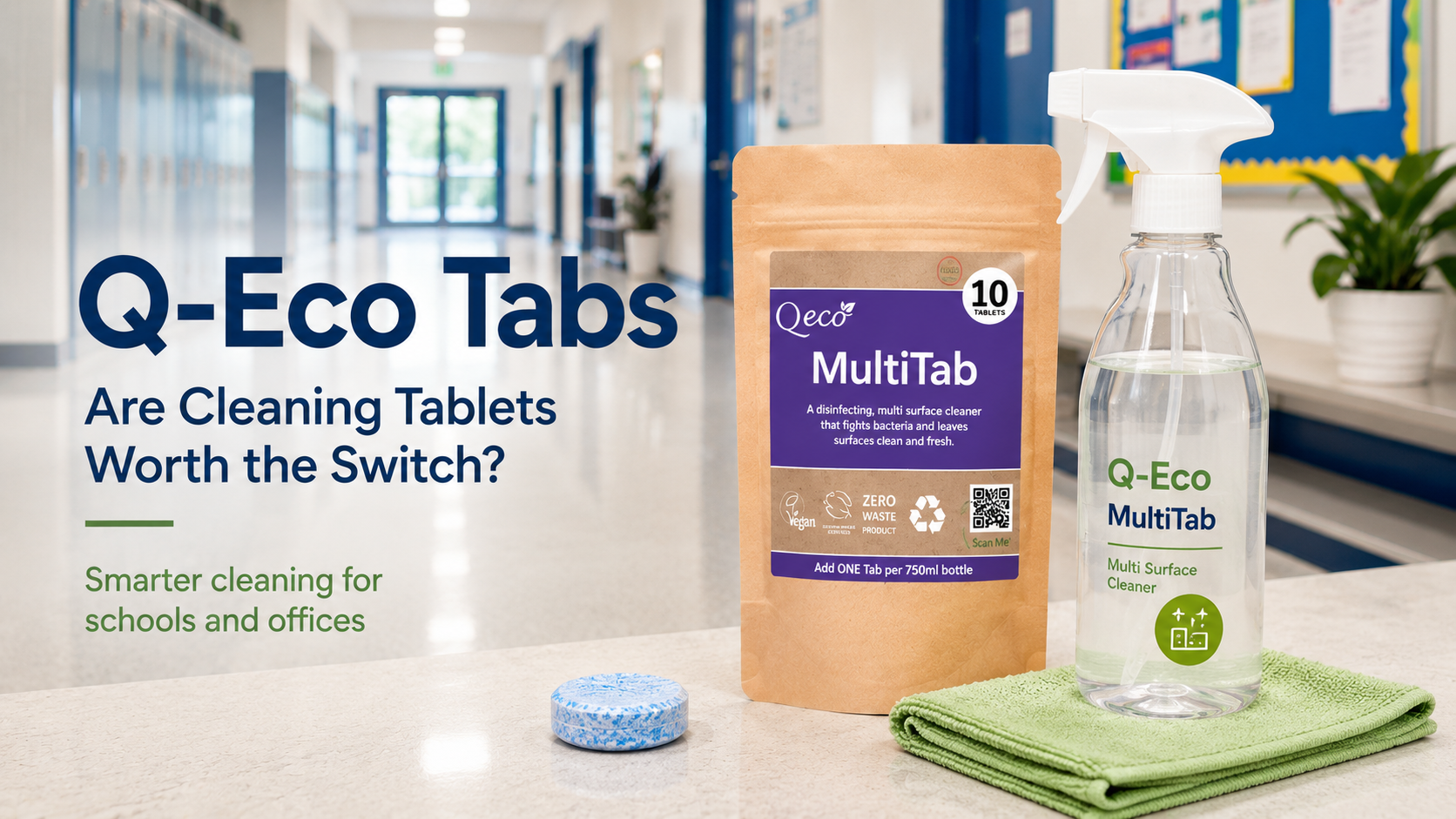
Q-Eco Tabs are concentrated cleaning tablets from Quattro. The product page explains that one tab is added to 750ml of water in a trigger bottle, then shaken before use. A pack of 10 tabs makes 10 x 750ml trigger bottles, and the sachet is also suitable for a 5 litre bucket where that method fits the task.
This is the core difference between cleaning tablets and traditional ready-to-use sprays. Instead of transporting and storing mostly water, the school or office stores compact tabs and creates the solution on site.
For B2B buyers, that changes the conversation. You are not only buying a cleaning product. You are changing the way cleaners refill bottles, manage stock and control dilution.
Why cleaning tablets appeal to schools and offices
Schools and offices both need reliable daily cleaning, but the pressure points are slightly different.
In schools, cleaners often cover classrooms, washrooms, offices, dining areas and shared spaces in tight time windows. Meanwhile, site managers need supplies that are easy to store, easy to reorder and safe to control around pupils. In offices, facilities teams usually focus on consistency, presentation, desk areas, washrooms, kitchens and glass.
In both settings, refillable cleaning products can reduce the number of disposable plastic bottles moving through the building. They can also reduce storage space, which matters in schools where cleaning cupboards are often small or shared with other site equipment.
However, the system only works if staff use it correctly. Q-Eco Tabs should be kept in a dry area, stored inside the packet until needed and handled with dry hands. Express also states that damaged tabs should only be handled while wearing PPE, with care taken to avoid contact with the eyes or skin.
The Q-Eco Tabs range, what each tab does
One reason Q-Eco Tabs are useful for schools and offices is that the range covers several common daily cleaning tasks. This makes it easier to standardise without using one product for everything.
Q-Eco SaniTab
Q-Eco SaniTab is a surface sanitiser. Express describes it as versatile and non-tainting, making it suitable for catering and food areas.
In practice, this makes it relevant for staff kitchens, dining support areas, break rooms and food-adjacent surfaces where a non-tainting product matters.
Q-Eco WashTab
Q-Eco WashTab is a disinfecting washroom cleaner. It lightly descales and is designed to work across washroom areas while helping fight bacteria.
For schools, this can support pupil toilets, staff washrooms and visitor facilities. However, heavy limescale or neglected urinals may still need a specialist descaler.
Q-Eco GreaseTab
Q-Eco GreaseTab is a degreaser designed to clean and degrease washable surfaces.
This suits staff kitchens, small food preparation points, dining support areas and general grease-prone surfaces. However, heavy kitchen carbon, ovens or industrial grease may still require stronger specialist products.
Q-Eco GlassTab
Q-Eco GlassTab can be used on glass, mirrors, stainless steel, UPVC and reflective surfaces.
This gives schools and offices a useful option for entrance doors, mirrors, internal glass panels, reception areas and meeting room partitions.
Q-Eco MultiTab
Q-Eco MultiTab is a fragranced disinfecting cleaner for washable hard surfaces, designed to fight bacteria.
For general classroom and office cleaning, this is likely to be the everyday tab in the range. It can help simplify daily surface routines where the task is general soil removal and hygienic wiping.
Where Q-Eco Tabs make the most sense
Q-Eco Tabs are not designed to replace every product in a cleaning cupboard. Instead, they work best across repeated daily tasks where cleaners use trigger sprays regularly.
Classrooms and workstations
Classrooms, desks, tables, doors and office workstations need frequent surface cleaning. Therefore, a tablet system can help keep the routine consistent.
For example, cleaners can refill labelled bottles at the start of a shift instead of searching for half-empty sprays. As a result, stock becomes easier to manage, and staff can follow the same process across multiple rooms.
Washrooms
Washrooms need products that clean reliably and support hygiene. WashTab is relevant here because it is designed as a disinfecting washroom cleaner with light descaling action.
However, schools should still keep separate specialist products for heavy toilet scale, urinal problems or drain odours. Cleaning tablets can support the daily routine, but they do not remove the need for periodic deep cleaning.
Offices and reception areas
Office environments often need presentable glass, desks, kitchens and shared touchpoints. GlassTab and MultiTab fit this mix well because they cover reflective surfaces and general washable hard surfaces.
In addition, small offices with limited storage may benefit from tabs more quickly than larger sites because they reduce the need to keep several cases of trigger sprays on site.
The main benefits for facilities teams
Less storage pressure
Storage is one of the clearest advantages. A small pack of tabs can replace multiple filled trigger bottles or ready-to-use spray stock.
This matters in schools, nurseries, offices and shared commercial buildings where cleaning storage is often limited. It also makes stock counts easier because teams can count tablets and bottles rather than mixed cases of liquids.
Better dilution control
Incorrect dilution is a common problem with traditional concentrates. Too weak, and the product may not perform. Too strong, and it wastes chemicals, increases residue and can create unnecessary exposure.
Q-Eco Tabs reduce that issue because the dose is already controlled. One tab goes into the correct amount of water, usually a 750ml trigger bottle.
Reduced single-use plastic
Because the system uses refillable bottles, it can reduce the number of disposable ready-to-use trigger bottles a site buys and throws away. For schools working on sustainability projects, this is a practical change pupils and staff can understand.
At the same time, it is not enough to buy the tablets and carry on as before. You need refillable bottles, clear labelling and a process for keeping bottles clean and in good condition.
Easier standardisation
Cleaning teams work better when systems are simple. If a school can use one bottle type, one labelling system and a small range of tabs, training becomes easier.
This is especially useful where multiple cleaners cover different buildings, or where caretakers and site teams need to support cleaning during absences.
Safety, COSHH and staff training
Q-Eco Tabs are designed to simplify cleaning, but they still need correct handling. Express states that when diluted, the Q-Eco Tabs are classified as non-hazardous. However, the undiluted powder is wrapped in a water-soluble film, and damaged tabs require PPE and careful handling.
Schools and offices should also keep Safety Data Sheets accessible and train staff on how to use the system. Express specifically advises users to read and follow the Safety Data Sheets provided.
This approach also aligns with wider HSE guidance for cleaning tasks. HSE notes that cleaning products can cause skin allergies, asthma, burns or eye damage depending on ingredients, and recommends safe storage, good working techniques, PPE where needed and good ventilation.
In practice, training should cover:
- which tab is used for which area
- how much water to use
- how to label the bottle
- how long to keep mixed solution
- how to handle damaged tabs
- where tabs and bottles are stored
- what PPE is required for specific tasks
What you need to make the system work
Cleaning tablets need a complete setup. Buying tabs alone is only part of the switch.
Express lists related items on the Q-Eco Tabs product page, including a 600ml bottle with trigger spray, a Robert Scott trigger spray for a 650ml bottle, a Quattro Q-Eco Tab 750ml bottle and a Quattro microfibre super cloth.
For schools and offices, the most important supporting items are:
- refillable trigger bottles
- durable trigger heads
- clear bottle labels
- microfibre cloths
- colour-coded cleaning systems
- safe storage containers
- PPE for handling damaged tabs
- a simple refill station or cupboard process
The bottle matters more than people think. If triggers fail, leak or become unlabelled, staff lose confidence in the system. For this reason, refillable bottles should be checked regularly and replaced when worn.
When Q-Eco Tabs may not be the right answer
Q-Eco Tabs are useful for many everyday cleaning tasks, but they are not the right product for every problem.
If a site has heavy limescale, blocked drains, severe grease, floor stripping, carpet stains, graffiti, mould or bodily fluid spillages, it may need specialist chemicals or separate procedures. In contrast, tablets are best for routine surface cleaning, washroom maintenance, glass cleaning, sanitising and degreasing washable surfaces.
Also, if staff are unlikely to refill bottles correctly, the switch needs more planning. A tablet system is simple, but it still depends on consistent behaviour.
The best decision is not “tablets or traditional chemicals”. It is deciding which products should move to tablets and which should stay as specialist solutions.
A practical rollout plan for schools and offices
A phased rollout usually works better than replacing everything at once.
Step 1: Audit current products
List every surface spray, washroom cleaner, glass cleaner, degreaser and sanitiser currently in use. Then identify duplicates and products that cleaners rarely use.
Step 2: Choose the first areas
Start with offices, classrooms, staff kitchens or standard washrooms. These areas usually give the clearest test of daily performance.
Step 3: Standardise bottles and labels
Use dedicated refillable bottles for each tab type. Labels should be clear, water-resistant and consistent across the site.
Step 4: Train staff before switching
Show staff how to fill bottles, add tabs, shake, store and report damaged tablets. Also explain which product should not be replaced.
Step 5: Review after one month
Check stock use, cleaner feedback, product performance, bottle condition and ordering patterns. Then decide whether to expand the system across more areas.
Buying checklist for Q-Eco Tabs
Before switching, ask:
- Which daily cleaning products could be replaced by tablets?
- Do staff already use trigger sprays regularly?
- Can bottles be labelled clearly and consistently?
- Do cleaning stores have dry storage for tabs?
- Who will refill the bottles?
- How will damaged tabs be handled?
- Which specialist chemicals still need to remain?
- Are microfibre cloths and colour-coded systems in place?
- Will the site use 750ml bottles or 5 litre bucket dilution where suitable?
- How will usage be reviewed after the first month?
This checklist helps decision-makers avoid a rushed switch and build a system that staff can follow.
FAQs
Are Q-Eco Tabs suitable for schools?
Yes, Q-Eco Tabs can be suitable for schools where cleaners need routine products for classrooms, washrooms, glass, kitchens and general hard surfaces. Schools should still use specialist products for tasks such as heavy descaling, drains or spill response.
How many bottles does one pack make?
A pack of 10 Q-Eco Tabs makes 10 x 750ml trigger bottles. Express also notes that one sachet is suitable for a 5 litre bucket.
Are Q-Eco Tabs non-hazardous?
Express states that Q-Eco Tabs are classified as non-hazardous when diluted. Undiluted tabs should be stored dry, handled with dry hands and managed carefully if damaged.
Which Q-Eco Tab is best for office cleaning?
MultiTab is the most relevant option for general washable hard surfaces. GlassTab is useful for mirrors, glass partitions, stainless steel and reflective surfaces.
Which Q-Eco Tab is best for school washrooms?
WashTab is the washroom option. It is designed to disinfect, lightly descale and work across washroom areas.
Do cleaning tablets replace all cleaning chemicals?
No. They can reduce the number of everyday sprays and support sustainable cleaning supplies, but specialist jobs may still need specialist products.
At Express Cleaning Supplies, we see Q-Eco Tabs as a sensible switch for schools, offices and facilities teams that want less waste, simpler storage and better dilution control. Used properly, they can make sustainable cleaning more practical without overcomplicating the daily routine.