



A cleaner can move from wiping classroom desks to descaling washroom fittings, clearing a spill and handling waste within the same shift. The job title stays the same, but the exposure changes with every task. For that reason, PPE for cleaning staff should never come from one standard kit worn everywhere.
At Express Cleaning Supplies, we recommend matching PPE for cleaning staff to the chemical, method and likelihood of contact. Disposable gloves may suit a short hygiene task, while a strong chemical, body fluid spill or dusty maintenance job may call for different gloves, an apron, eye protection or carefully selected respiratory protection. The aim is not to wear more PPE. It is to use the right protection within a properly controlled cleaning process.
Start with the risk, not the PPE cupboard
PPE is the final layer of control, not the first. Before issuing protective clothing for cleaners, employers should consider whether they can use a safer product, improve ventilation, change the application method or prevent splashing. HSE guidance says PPE should support other controls when those measures cannot adequately manage exposure. It protects only the wearer, and only while it fits, functions and is worn correctly.
A task assessment should consider the Safety Data Sheet, concentration, duration, ventilation and likelihood of splash, mist, dust or biological exposure.
Where a risk assessment shows PPE is required, employers must provide it without charging workers. They must also give suitable information, instruction and training, then maintain, store and replace the equipment.
Cleaning PPE checklist by task
A practical cleaning PPE checklist starts with the work being carried out:
- Routine desks, doors and low-risk surfaces: gloves only where the product assessment requires them, plus normal workwear and suitable footwear.
- Washroom cleaning and light descaling: compatible reusable gloves, a splash-resistant apron and eye protection if splashing is foreseeable.
- Strong descalers, drain cleaners or concentrates: chemical-resistant gloves selected from product data, protective clothing and suitable eye or face protection.
- Body fluid spills: disposable gloves and apron, with eye and facial protection where the risk assessment identifies splashing.
- Machine floor cleaning: protection for filling and emptying tanks, suitable footwear and safe wet-floor controls.
- Dusty deep cleaning: dust suppression and ventilation first, followed by suitable respiratory protective equipment only where necessary.
- Waste and grounds work: durable gloves, protective footwear and high-visibility clothing where vehicles or poor visibility create a risk.
The label, Safety Data Sheet and site assessment must decide the final PPE for cleaning staff.
Disposable gloves for cleaning
Nitrile, vinyl and latex have different uses
Disposable gloves for cleaning suit tasks requiring hygiene, dexterity and regular changes. Our range includes nitrile, latex and vinyl options, plus reusable rubber, PVC and nitrile-coated gloves. Nitrile offers useful puncture resistance, vinyl can suit short low-risk handling, and latex offers elasticity, although sites must account for sensitivity.
However, glove material alone does not prove suitability. A thin nitrile glove may resist one diluted detergent but fail quickly against another concentrate. HSE advises checking breakthrough time, permeation rate and degradation data for the actual chemical. For mixtures, selection should follow the component with the shortest breakthrough time unless the manufacturer supplies mixture-specific evidence.
When reusable gloves work better
Reusable chemical-resistant gloves often suit prolonged washroom work and repeated water contact. Choose cuff length, grip and resistance around the task. Longer gauntlets may protect the wrist and lower arm from splashes.
Fit matters too. Tight gloves reduce movement, while loose gloves weaken control. Staff should inspect reusable gloves for holes, swelling, stiffness or surface damage before use. Disposable gloves must not be washed and reused, and hands should be washed and dried after glove removal.
Aprons, oversleeves and coveralls
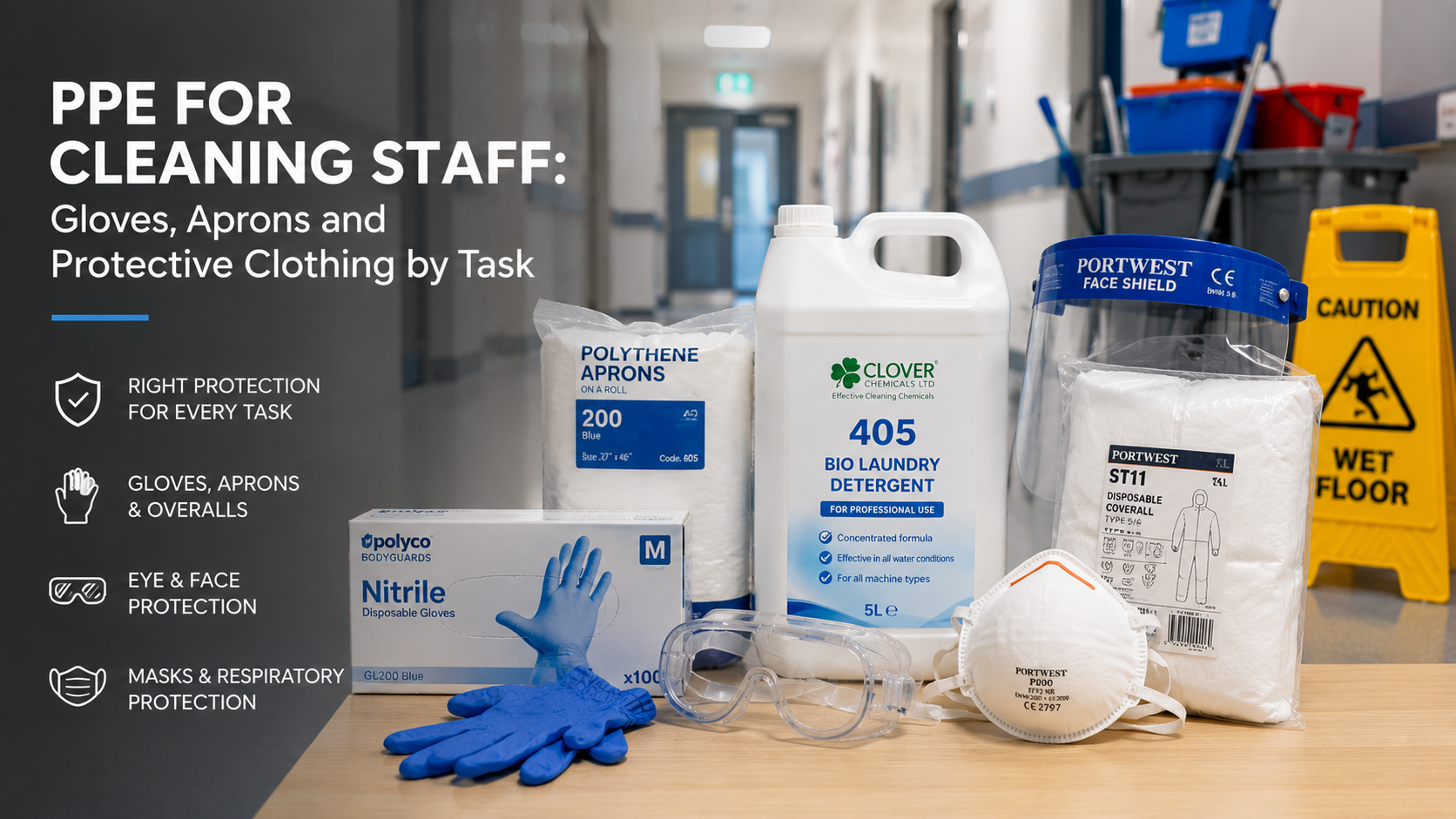
A lightweight polythene apron works well for short washroom checks, food-area cleaning and body fluid spill response where the main risk is front-of-body contamination. Express stocks Polyco Healthline Polythene Aprons on a Roll x200, disposable flat-packed aprons and oversleeves, which support fast changes between areas.
For heavier work, a wetproof reusable apron or fuller protective clothing may provide better coverage. Disposable coveralls can also help during dusty storeroom work, specialist deep cleans or tasks where contamination could reach normal workwear. Our range includes the Portwest Disposable Hooded Coverall ST11 and disposable hooded boilersuits.
Protective clothing for cleaners should allow free movement without trailing, catching or excessive heat. Procurement teams also need realistic size options.
Eye and face protection
Chemical splash can reach the eyes during dilution, toilet descaling, drain treatment and machine tank emptying. Safety spectacles may suit some low-level risks, while goggles or a face shield may be needed where broader splash protection is required.
Express stocks eye and face protection including the Portwest Face Shield Plus Clear PW96. A face shield provides wider facial coverage, but it must match the hazard and remain compatible with any mask, respirator or head protection.
Staff should know where this equipment is stored and how to inspect it. Scratched, cloudy or loose-fitting protection reduces visibility and encourages removal during the task.
Masks and respiratory protection
A face covering, surgical-type mask and respirator are not interchangeable. A basic face mask can support hygiene in some settings, but it does not automatically protect a cleaner from hazardous dust, chemical mist, gas or vapour.
Our range includes disposable face coverings and the Portwest FFP2 Face Mask P200. An FFP2 respirator may suit certain particulate hazards, but the exposure assessment must drive selection. A particulate filter does not protect against chemical vapours unless the device includes the correct filter for that substance.
Tight-fitting respiratory protective equipment also needs to fit the individual wearer. HSE guidance requires competent fit testing because one model or size will not seal correctly on everyone. Sites also need rules for facial hair, storage, inspection and replacement.
In routine work, ventilation, controlled dosing and avoiding unnecessary spraying will often reduce exposure more effectively than simply handing out masks.
Protective footwear for cleaners
Cleaning teams work around wet surfaces, trolleys, machines and waste. Our range includes slip-resistant shoes and trainers, waterproof boots, safety footwear and disposable overshoes. Slip-resistant footwear can suit kitchens, washrooms and wet areas, while waterproof boots may be more appropriate for grounds work or heavy washdown. Toe protection may be required where staff move machines, bulk chemicals or heavy containers.
However, footwear does not make an unsafe floor safe. Teams must still control spills, segregate wet areas and replace footwear when worn tread or damage affects grip.
PPE for school cleaners and body fluid spills
PPE for school cleaners needs a clear protocol for vomit, blood, faeces, saliva and other body fluid spills. Education guidance says staff should clean these spillages promptly while wearing PPE. Gloves and an apron form the basic protection, while the likelihood of splashing determines whether facial and eye protection is also needed.
Schools should keep the required PPE with, or immediately beside, the body spill kit. Otherwise, staff may start work before protection arrives. The process should also cover hand hygiene, disposal, contaminated clothing and escalation where sharps or broken glass are present.
For larger spills, waterproof footwear or disposable overshoes may be appropriate. Staff should never collect broken glass by hand, even while wearing gloves.
Stock control, training and replacement
PPE fails operationally when the correct item exists but sits in another building, comes in the wrong size or has run out. Therefore, larger sites should hold PPE by task and location rather than keeping everything in one central cupboard.
A practical stock plan includes:
- glove sizes that fit the whole team
- separate disposable and reusable gloves
- aprons beside body spill and catering cleaning points
- goggles or face shields near controlled chemical stores
- coveralls for planned deep-cleaning work
- suitable footwear by role
- clean, labelled storage away from used equipment
- defined reorder points for disposable lines
Training should explain why each item is needed, how to put it on, how to remove it without transferring contamination and when to replace it. Reusable PPE needs an inspection and cleaning schedule, while single-use items need clear disposal rules.
At Express Cleaning Supplies, we stock gloves, aprons, coveralls, face protection, masks, respirators and footwear for schools, offices, hospitality, healthcare-adjacent settings and commercial cleaning teams. We also support bulk and local authority purchasing, helping larger organisations standardise their cleaning PPE checklist across sites.
Common PPE mistakes to avoid
The first mistake is choosing PPE by job title. A cleaner wiping desks does not face the same risk as a caretaker pouring drain cleaner.
The second is assuming all nitrile gloves resist all chemicals. Product information and glove compatibility data must guide the choice.
The third is relying on PPE instead of controlling the task. Better ventilation, closed dosing and slower pouring may reduce exposure more effectively.
The fourth is confusing a face mask with suitable respiratory protection. Dust, mist and vapour require different equipment.
Finally, avoid one-size purchasing. Poor fit affects grip, visibility, movement and whether staff wear the equipment correctly.
FAQs
What PPE do cleaning staff need?
The task assessment decides. Common items include suitable gloves, aprons, eye protection, protective footwear, coveralls and, for specific airborne hazards, correctly selected respiratory protection.
Are nitrile gloves suitable for all cleaning chemicals?
No. Suitability depends on the chemical, concentration, contact time and glove specification. Check the Safety Data Sheet and the glove manufacturer’s resistance information.
When should cleaners wear an apron?
Wear an apron where a task could splash or contaminate clothing, including washroom cleaning, body fluid spills, food-area work and some chemical dilution tasks.
Do school cleaners need face shields?
Not for every task. A face shield or goggles may be required where splashing could reach the face or eyes, such as certain spill responses, drain treatments or strong chemical dilution.
Is an FFP2 mask suitable for chemical fumes?
Not by default. FFP2 respirators address certain particulate exposures. Chemical vapours need a device and filter selected specifically for that hazard.
Who pays for PPE for cleaning staff?
Where the workplace risk assessment requires PPE, the employer must provide it free of charge and take responsibility for its maintenance, storage and replacement.
How often should cleaning PPE be replaced?
Replace disposable PPE after its intended single use. Replace reusable PPE when damaged, contaminated beyond safe cleaning, past its service life or no longer able to provide the required protection.
Assess the task, reduce the risk, select compatible PPE, train staff and keep replacements close to the work.