



Care homes and residential schools share a lot in common when it comes to housekeeping. Both run round the clock, both have residents living there full time rather than passing through for a few hours, and both need housekeeping stock that matches genuine daily use rather than a standard school-day pattern. Care homes carry an extra layer on top of that: residents who are often more vulnerable to infection, and a standard of care that's actively inspected rather than assumed.
This guide works through the housekeeping essentials that matter most in a care setting, with a look at where residential schools share the same needs.
Why housekeeping in care settings carries extra weight
In a care home, housekeeping isn't just about appearance and comfort, it's part of protecting residents who are often more susceptible to infection than the general population. A cleaning routine that would be perfectly adequate in an office or even a school takes on a different level of importance when the people living there are frail, elderly, or managing health conditions that make infection genuinely dangerous.
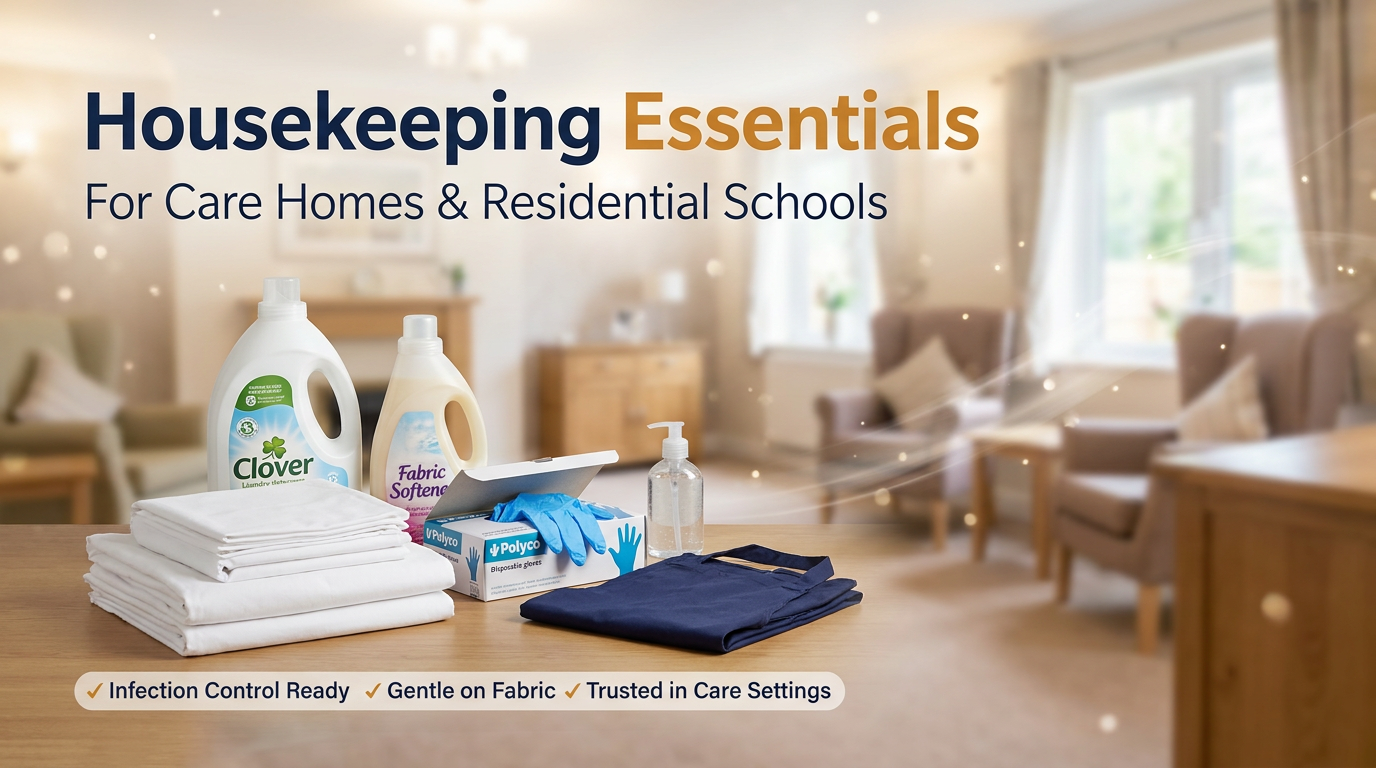
This is also a sector Express already supports closely through First Aid and PPE supplies, and housekeeping sits right alongside that. Gloves, aprons and hand sanitiser used during care routines and the surface cleaners, laundry products and communal-area supplies used during housekeeping rounds are really part of the same infection control picture, not two separate concerns.
Laundry that holds up to a higher standard
Laundry volume in a care home is significant, and it needs products that hold up to frequent washing without breaking down fabric or leaving residue that could irritate sensitive skin. Detergent, fabric softener and stain removers all need to work reliably at whatever wash frequency and temperature the setting's own infection control policy requires, since many care settings follow specific laundering guidance for items that need a higher standard of hygiene, not just a standard domestic wash.
It's worth checking laundry stock levels against actual resident numbers and wash frequency rather than a fixed reorder pattern, in the same way a boarding school would review its own laundry volume. A care home running additional loads for infection control reasons will go through detergent and fabric softener noticeably faster than the same size site running a lighter, more standard laundry routine.
Guest-style amenities and resident dignity
Toiletries, essentials and refill items for resident rooms matter more in a care setting than the small cost of the items themselves would suggest. For someone living in a care home full time, a well-stocked, comfortable room is part of quality of life, not just housekeeping tidiness, and running short on these basics affects residents directly in a way it wouldn't in a workplace setting.
Families visiting residents notice these details too, often without saying so directly. A room and communal area that's visibly well stocked and cared for says more about the standard of care than any amount of explanation, and it's one of the small, cumulative things that shapes how a care home is perceived by the people who matter most.
Keeping communal areas properly maintained
Lounges, dining rooms and shared spaces get heavy daily use in a care home, often by residents with limited mobility who spend most of their day in these areas rather than moving through the building. Furniture polish and metal polish for shared furniture, glass cleaners for windows and partitions, and surface wipes for tables and shared equipment all need restocking on a tight cycle to keep pace with that level of use.
Air fresheners and deodorisers matter here too, and in a care setting they need thinking about carefully rather than simply choosing the strongest option. Some residents are sensitive to strong fragrances, so a lighter, more considered approach to odour control often works better than an overpowering one.
Where housekeeping meets infection control
Housekeeping and infection control overlap constantly in a care setting, and stocking them together makes practical sense. PPE used during personal care routines, gloves, aprons and hand sanitiser, needs to be available in the same places housekeeping staff are working, not stored separately as though the two activities are unconnected.
Surface disinfectants used during housekeeping rounds should meet whatever standard the setting's own infection control policy sets, and it's worth checking this policy directly rather than assuming a general-purpose cleaner is sufficient for every area. High-contact surfaces, door handles, light switches, shared equipment, generally need more frequent attention than in a typical workplace, simply because of how often they're touched across a full day of resident and staff activity.
Housekeeping in residential schools
Residential schools share much of this same pattern. Bedrooms, laundry rooms and communal areas are in near-constant use, and housekeeping stock needs to be reviewed against actual occupancy rather than a fixed school-term order. The infection control considerations are generally lighter than in a care home, but the underlying principle, stock levels that reflect genuine daily use rather than an estimate, applies just as strongly.
Boarding house laundry sees a predictable pattern of everyday stains and heavy use, and having proper stain treatment and fabric care products on hand protects linen and keeps it looking presentable for considerably longer than a standard wash cycle alone.
Training staff on housekeeping standards
Care home housekeeping teams often include a mix of permanent staff, agency cover and, in some settings, care staff who take on light housekeeping duties alongside personal care responsibilities. That mix makes consistent training more important than in a typical workplace cleaning team, since not everyone doing the work will have the same background in housekeeping or infection control standards.
A short, written reference covering laundry procedures, stock locations and what properly stocked looks like for each area gives new or occasional staff something concrete to follow, rather than relying on picking it up as they go. This matters particularly around surface disinfectants and laundry products, where using the wrong item on the wrong surface or fabric can do more harm than good, and a quick reference helps agency or temporary staff work to the same standard as permanent team members from their first shift.
Record keeping matters here too. Many care settings are expected to demonstrate that cleaning and infection control routines are actually being followed, not just planned, so a simple log of what's been cleaned and when gives staff and management alike a clear, checkable record rather than relying on memory.
Budgeting and stock planning for a care home
Housekeeping consumables in a care home follow a different usage pattern to a typical workplace, since demand is driven by occupancy, infection control routines and resident needs rather than a fixed office headcount. Tracking actual usage of detergent, fabric softener, surface disinfectants and PPE against resident numbers gives a far more accurate reorder pattern than simply repeating the previous order.
A sensible approach is to hold a two to three week buffer of fast-moving items, laundry products, surface disinfectants and PPE, and reorder before that buffer is touched rather than after a shortage becomes obvious. Guest-style amenities and lower-turnover communal items can generally run on a longer four to six week lead time without risking a gap in provision. It's also worth flagging any change in resident numbers or an outbreak period to whoever manages the order, since both can shift usage considerably from one month to the next.
Building a housekeeping checklist for your setting
A written checklist split by area, resident or bedrooms, laundry, communal spaces, gives staff a clear reference rather than relying on memory or handover between shifts. This matters particularly in care settings with rotating staff or agency cover, where a new starter won't yet have a feel for what properly stocked looks like on that specific site.
Reviewing stock against the checklist regularly, rather than only when something runs out, catches gaps before they become a genuine shortage. Many care homes and residential schools find it easier to manage this by sourcing housekeeping, laundry and PPE supplies from a single account with Express Cleaning Supplies, rather than piecing orders together from several different suppliers.
FAQ
Why does housekeeping matter more in a care home than a typical workplace? Residents are often more vulnerable to infection, and housekeeping standards form part of the wider infection control picture, not just general tidiness.
Should housekeeping and PPE supplies be stocked together in a care home? It generally helps. Housekeeping and infection control routines overlap constantly in a care setting, so keeping PPE, hand hygiene products and cleaning supplies accessible in the same areas supports both at once.
How often should communal areas in a care home be cleaned and restocked? More frequently than a typical workplace, since residents often spend most of the day in shared spaces like lounges and dining rooms rather than passing through briefly.
Do residential schools have the same infection control needs as care homes? Generally lighter, but the same underlying principle applies: housekeeping stock should match actual occupancy and usage rather than a fixed reorder pattern.