




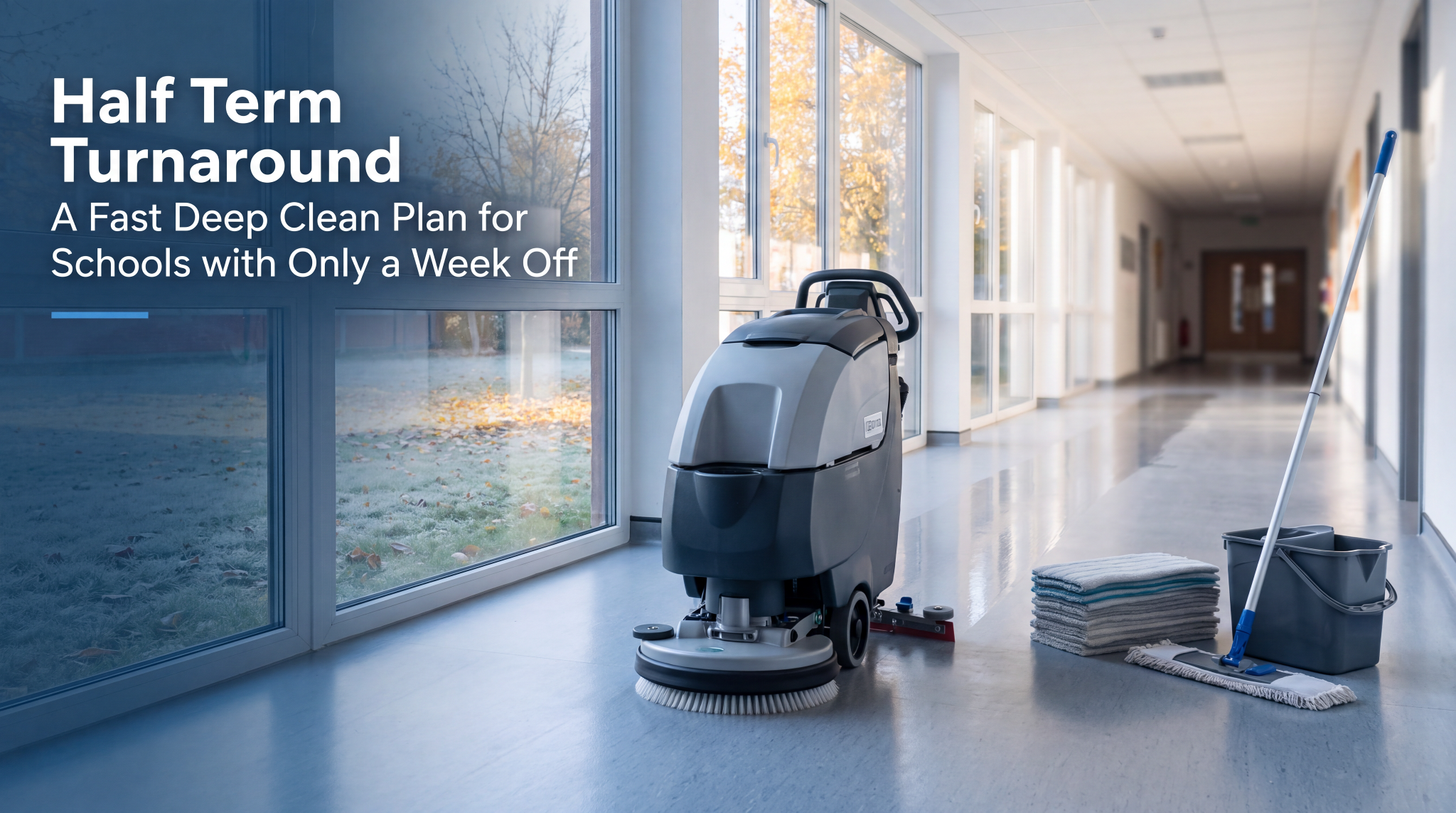
Not every school gets a generous break between terms. Many sites have a single week in October half term before students are back, which is a genuinely tight window for anything beyond the daily cleaning routine. Trying to run the same deep clean plan a site would use over a longer break, just compressed into fewer days, usually means nothing gets finished properly. A one-week turnaround needs its own plan built around speed and priority, not a scaled-down version of a longer one.
This guide works through how to plan a fast but genuinely effective deep clean when half term only gives a facilities team a single week to work with.
Why a tight turnaround needs a different plan
A longer break allows a site to work through every area in turn, giving each one proper attention before moving to the next. A single week removes that luxury. Trying to spread the same amount of work across a fifth of the time usually means every area gets a rushed, partial clean rather than a smaller number of areas getting finished properly.
The better approach is triage. Deciding in advance which areas genuinely need attention this half term, and which can reasonably wait until Christmas, means the time available goes toward what actually matters most rather than being spread too thin to make a real difference anywhere.
Prioritising the areas that matter most
Entrances, main corridors and halls carry the heaviest daily foot traffic in most schools, which makes them both the first areas to show wear and the ones where a visible deep clean makes the biggest difference. These are the areas worth prioritising when time is short, ahead of lower-traffic classrooms or storage areas that can hold until a longer break comes around.
Washrooms deserve a place near the top of that priority list too, given how heavily they are used and how quickly visible wear and odour build up without proper attention. A targeted refresh here, rather than the full strip-back a longer break would allow, still makes a meaningful difference to how the space is perceived when students return.
Choosing equipment that saves time, not just chemicals
Equipment choice matters more in a tight turnaround than it does over a longer break, since the right machine can finish a job in a fraction of the time a slower one would take. A scrubber dryer from a brand like Numatic, Truvox, Viper or i-Team covers far more floor area per hour than manual mopping, and it leaves floors usable again almost immediately rather than needing a long drying window.
For an even faster pass on hard flooring, an I-Mop style machine is worth considering specifically for its combination of cleaning and near-instant drying, which matters when every hour of the week is accounted for. Battery-powered equipment is also worth factoring in over corded alternatives where available, since not having to manage cables and sockets across a large open space saves real time over the course of a full day's cleaning.
Floor pads matched correctly to the job also save time that would otherwise be lost to redoing a pass with the wrong grade. A pad too soft for the level of grime leaves a job half finished, while one too aggressive risks damaging a floor that then needs remedial attention later, costing more time than it saved.
Floorcare jobs that fit a one-week window
Full floor stripping and resealing, the kind of job that needs a floor left genuinely untouched for hours to cure properly, is often unrealistic to attempt across an entire site in a single week. Limiting this specific job to the one or two highest-priority areas identified during the triage step, rather than attempting it everywhere, is usually the more realistic approach.
Everywhere else, a thorough scrubber dryer pass combined with a mop head and pad refresh delivers a strong visible improvement without needing the same drying time a full strip and reseal demands. Checking and rotating worn mop heads and pads as part of the same pass means the equipment itself is not slowing the job down through the week.
Washroom jobs that matter most when time is short
A full tile and grout deep clean, along with every dispenser and fitting being checked individually, is the kind of thorough washroom work better suited to a longer break. In a one-week turnaround, prioritising a genuine deep clean of the highest-use washrooms, along with a quick check of dispensers and consumable stock across every other washroom on site, covers the areas that matter most without the whole job stalling partway through.
Replacing anything visibly worn, a cracked dispenser, a damaged seat, a failing urinal screen, during this same pass avoids leaving a known issue to deal with reactively once term is already underway and the next opportunity to fix it properly is months away.
Planning the week so it actually gets finished
A day-by-day plan, built around the priority list rather than an attempt to cover everything, is what makes a one-week turnaround realistic. Deciding on day one which jobs are genuinely must-do and which are nice-to-have, and being willing to drop the nice-to-have list if time runs short, avoids the common trap of running out of week with the highest-priority jobs still unfinished.
If contract or agency support is being brought in for the week, it is worth directing that extra capacity at the single hardest job, typically the main floor strip and reseal in the highest-traffic area, rather than spreading it thinly across several smaller tasks. A focused team working on one demanding job tends to produce a better result than the same hours split across many smaller ones.
What to do if the week genuinely isn't enough
Even with good planning, a single week sometimes is not enough to get through everything a site would ideally want done. When that happens, it is worth keeping a simple record of what was deliberately deprioritised, so it becomes the starting point for the Christmas break plan rather than something that gets forgotten until it becomes urgent again.
This also helps build a more accurate picture over time of how much a one-week turnaround can genuinely achieve for a particular site, which makes planning the next half term considerably easier than starting from scratch each time.
Communicating the plan to staff and any temporary cover
A fast turnaround depends on everyone involved knowing the plan before the week starts, not discovering it on the first morning. Sharing the priority list with the full team, including any agency or temporary staff brought in specifically for the week, means everyone is working from the same understanding of what must be finished and what can wait.
This matters particularly where a team includes staff who are not on site every week and therefore have less built-in sense of which areas typically need the most attention. A short written brief, even a single page listing the priority areas and the must-do versus nice-to-have split, gives temporary staff something concrete to follow rather than relying on verbal instructions that can get lost across a busy week.
Recording what was achieved for next time
Keeping a short record of what was actually completed during the week, alongside what had to be dropped from the plan, turns a single rushed half term into useful information for every future one. Over a few cycles, this record shows which jobs reliably fit into a one-week window and which consistently need to be pushed to a longer break, which makes planning considerably easier than starting from a blank page each time.
It also helps when justifying resourcing decisions, whether that is bringing in contract support for a specific job or adjusting staffing for future half terms. A documented pattern of what a one-week turnaround can and cannot achieve is more persuasive than a general sense that the team is always stretched during these weeks.
Deciding what counts as finished for a short turnaround
It helps to agree, before the week starts, what a realistic finish point actually looks like for a one-week turnaround. A full strip and reseal finished to the same standard as a longer break is rarely the right benchmark. A visibly improved, properly refreshed space that holds up well until the next longer break is a more useful measure of success for this specific window.
Setting that expectation with the wider team, including senior leadership who may be used to seeing the results of a longer summer clean, avoids the week being judged against a standard it was never designed to meet. A short, clear note explaining what was prioritised and why tends to land better than leaving people to draw their own comparison with a different kind of break entirely.
FAQ
What should be prioritised first in a one-week half term turnaround? Entrances, main corridors and halls, since they carry the heaviest daily use and show the most visible improvement from a focused deep clean.
Is it realistic to strip and reseal floors across a whole school in one week? Usually not for a large site. Limiting a full strip and reseal to the one or two highest-priority areas, rather than the whole building, tends to be a more realistic use of a single week.
Does equipment choice really make a meaningful difference in a short turnaround? Yes. Faster-drying equipment like an I-Mop style machine, along with battery-powered options that avoid cable management, can meaningfully increase how much ground a team covers in a fixed amount of time.
What should happen to jobs that don't get finished during half term? Keeping a simple record of what was deprioritised turns it into the starting point for planning the next break, rather than something that gets forgotten until it becomes a bigger problem.