



A first aid box can look full and still be unready. Plasters may be missing, sterile dressings may be near expiry, and the cold pack taken on the last trip may never have returned.
Our first aid kit checklist helps schools, offices and multi-site facilities review supplies before buildings become busy again. A reliable first aid kit checklist does not start with a universal shopping list. It starts with the site’s first aid needs assessment, then confirms that every kit is complete, accessible, in date and positioned where staff can reach it without delay. HSE requires workplace provision to be adequate and appropriate, while Department for Education guidance recommends that schools also consider pupils, students and visitors.
Start with the first aid needs assessment
The number, size and contents of kits should reflect the hazards, layout, workforce and people using the premises. A small administrative office has different needs from a secondary school with science rooms, kitchens, workshops, sports pitches and several buildings.
At least one suitably stocked kit should be available at each workplace. However, larger, split-level or higher-risk sites may need several. Schools may also need separate provision for distant playgrounds, sports fields and off-site activities. It should also account for holiday clubs, contractors and staff working away from the main building.
British Standard BS 8599-1 can provide a useful purchasing framework, but it is not a legal requirement in itself. The contents must still match the first aid needs assessment. At Express Cleaning Supplies, we stock workplace kits and refills in different sizes, helping buyers select a practical starting point without assuming that one box suits every location.
What should the checklist cover?
For a low-risk workplace, HSE’s suggested baseline includes basic first aid guidance, individually wrapped sterile plasters, sterile eye pads, triangular bandages, safety pins, medium and large sterile unmedicated wound dressings and disposable gloves. This is guidance, not a fixed legal contents list.
Schools and larger organisations may identify extra needs, such as cleansing wipes, cold packs, burns supplies, foil blankets, safety shears or eye irrigation. For example, sports areas may need cold packs, while laboratories may require more substantial eye care.
A practical first aid kit checklist for a school should cover:
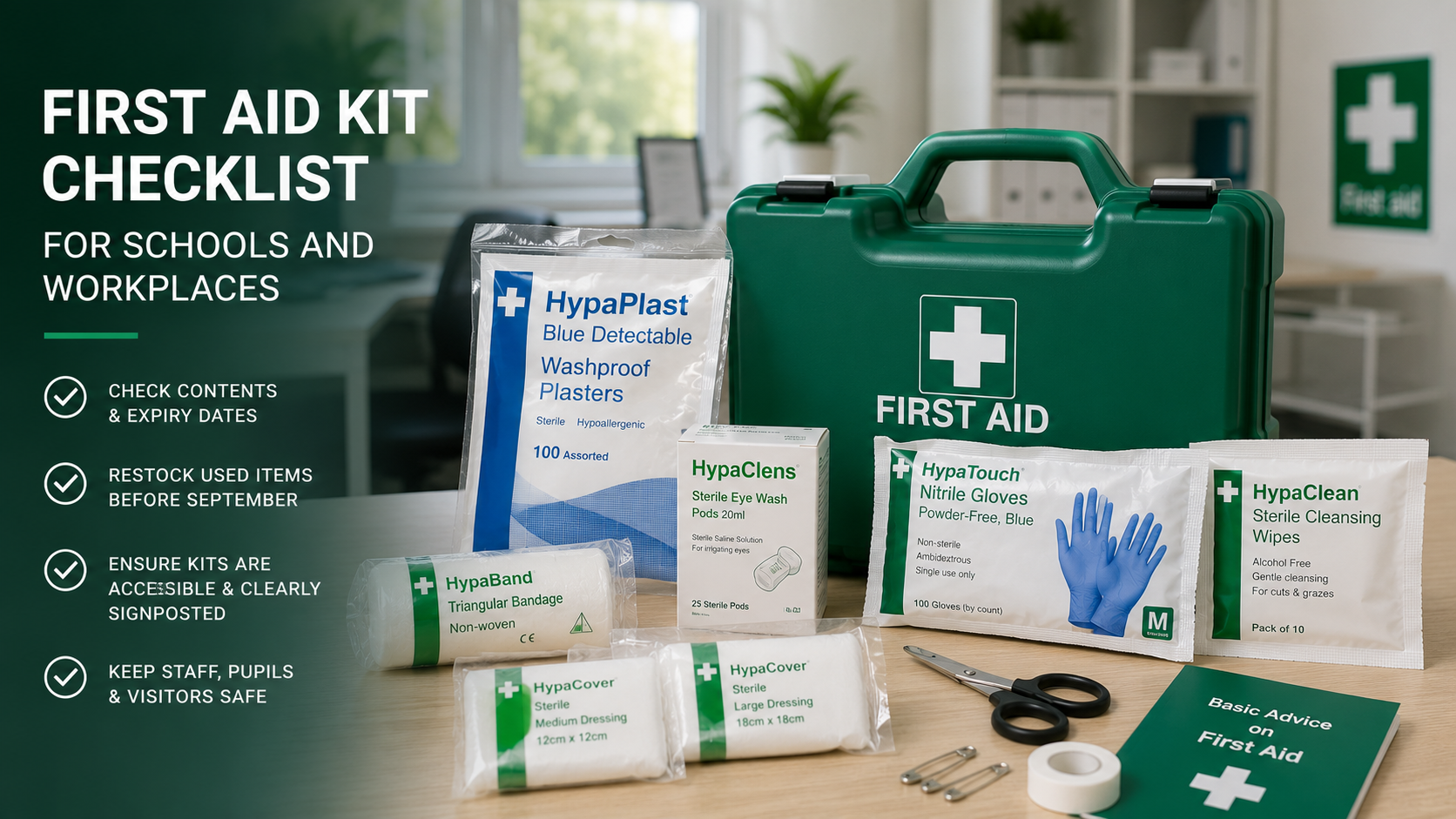
- Sterile plasters in useful sizes
- Medium and large wound dressings
- Sterile eye pads
- Triangular bandages and safety pins
- Disposable gloves
- Cleansing wipes where required
- Cold packs where the assessment identifies a need
- Eye wash products for relevant locations
- Scissors or safety shears where required
- Clear first aid guidance
- A clean, secure and recognisable container
Check plasters, dressings and gloves
Plasters disappear quickly because they handle many everyday minor injuries. Count them by size and type, then check that every wrapper remains sealed. Schools may need child-friendly options, while catering areas often use blue detectable plasters.
Inspect dressings for punctures, moisture, crushed packaging or opened seals. Similarly, make sure bandages remain wrapped and that disposable gloves are dry, intact and available in suitable quantities. Gloves support infection control, but they do not replace hand hygiene.
Express supplies Safety First Aid Economy First Aid Kits in small, medium and large formats. The reusable green cases contain dressings, plasters, wipes and gloves, with an optional wall bracket. We also stock Safety First Aid Workplace First Aid Kit Refills, so organisations can replenish a sound container rather than replace it.
Review wipes, eye care and cold packs
First aid cleansing wipes must suit their intended use and remain sealed and in date. DfE’s travelling-kit guidance includes individually wrapped moist cleansing wipes, which makes them particularly relevant for trips and mobile kits.
Eye care should reflect the hazard. Offices may need eye pads, while laboratories, workshops and chemical stores may need sealed eye wash within immediate reach.
Where mains tap water is not readily available for eye irrigation, HSE advises providing at least one litre of sterile water or sterile normal saline in sealed disposable containers. Opened containers must not be saved for reuse. Express stocks Safety First Aid Eye Wash Solution Pods 20ml x25, HypaClens Sterile Eye Wash 250ml and the HypaClens Value Eye Wash Station. Buyers should calculate total volume and placement rather than assuming one small bottle is enough.
Cold packs are useful where bumps and strains are foreseeable, although they sit outside HSE’s basic low-risk list. Check reusable packs for leaks and instant packs for damage or expiry. The Safety First Aid HypaGel Hot/Cold Therapy Pack can suit first aid rooms, sports areas and mobile kits.
Check expiry dates before the August rush
Sterile items often carry expiry dates, so a visual check of the box is not enough. HSE advises replacing expired stock and disposing of it safely. If a sterile item has no visible date, check the manufacturer’s guidance. Non-sterile items should still be inspected to confirm that they remain fit for purpose.
Record the earliest expiry date in each kit and set a forward replacement window. A stock card or shared spreadsheet can work, provided a named person owns the process.
A simple system is:
- Red: used, opened, damaged or expired, replace now
- Amber: approaching the organisation’s replacement window
- Green: sealed, in date and fit for purpose
A documented first aid kit checklist makes first aid refills predictable and reduces urgent orders during the first weeks of term.
Put kits where people can reach them
A kit should be visible and accessible, not locked in an office that may be empty. HSE recommends first aid identification using a white cross on a green background. DfE also says containers should be clearly labelled and, where possible, kept near hand-washing facilities.
In schools, suitable locations include reception, medical rooms, sports areas, kitchens, workshops and separate buildings. Offices may need kits near reception, kitchens and on different floors. One central box is not enough if reaching it would delay assistance.
Travelling kits matter too. Before an educational visit or off-site task, the responsible person should assess the activity and take suitable provision. Specialist activities may require more than the suggested minimum travelling kit.
Build a refill routine that survives term time
Every kit needs a named owner, and the first aid kit checklist should record that responsibility. Their duties should include frequent checks, immediate restocking after use and keeping access clear.
We recommend three levels of control:
- After every use: replace consumed items and record the incident.
- Monthly or locally agreed check: inspect quantities, seals, condition and access.
- Termly review: check expiry dates, locations, usage trends and whether the needs assessment still fits the site.
September is also a sensible time to review first aider cover and certificate dates. DfE notes that certificates are usually valid for three years and strongly recommends annual refresher training. Major changes to staffing, premises or activities should also trigger a review.
Keep useful records
Incident records help identify repeat problems. DfE recommends recording the date, time, location, person involved, injury or illness, first aid provided, outcome and person dealing with the incident. This first aid record is not automatically the same as the statutory accident book, although systems may be combined appropriately.
Express stocks the Medikit A4 First Aid Accident Report Book for organisations using a paper-based process. Keep records secure and follow your data protection and reporting procedures.
Medication should not be stored in the general first aid kit. HSE and DfE distinguish first aid supplies from medicines, while schools should manage pupil medication through separate procedures.
Pre-September first aid kit checklist
Before reopening, confirm that:
- The first aid needs assessment reflects current buildings, staffing and activities.
- Every site has at least one suitable, fully stocked kit.
- Additional kits cover remote, split-level and higher-risk areas.
- Plasters, dressings, bandages and eye pads are sealed and in date.
- Gloves and cleansing wipes are present where required.
- Eye wash volume and placement match identified risks.
- Cold packs and specialist supplies are complete and undamaged.
- Expired, opened or damaged stock has been replaced.
- Kits are clearly identified, visible and unobstructed.
- Travelling kits are ready for visits, vehicles and off-site work.
- A named person owns checks and first aid refills.
- First aider cover and certificate dates have been reviewed.
- Incident records and emergency contact arrangements are ready.
Common mistakes to avoid
The first mistake is treating a sealed box as proof that its contents are complete. Stock can expire unopened.
The second is centralising every item. One full kit cannot serve a large campus if staff cannot reach it quickly.
The third is buying to a standard without reviewing site risks. BS 8599-1 can guide purchasing, but the needs assessment still decides the final provision.
Finally, keep medicines, cleaning chemicals and unrelated supplies out of the first aid container. Clear organisation matters during an emergency.
FAQs
What should a school first aid kit contain?
The contents should follow the school’s first aid needs assessment. A baseline normally includes sterile plasters, eye pads, bandages, wound dressings, disposable gloves and first aid guidance, with additional items for site-specific risks.
How often should first aid kits be checked?
HSE and DfE say kits should be checked frequently and restocked promptly after use. Many organisations add a documented monthly check and a deeper termly review.
Do first aid kits have to comply with BS 8599-1?
No. It is a recognised purchasing standard, but it is not mandatory. The kit must meet the needs identified by the employer’s assessment.
Where should first aid kits be located?
They should be visible and quickly accessible. Large schools may need kits in reception, medical rooms, sports areas, playgrounds, kitchens, workshops, separate buildings and trip bags.
Can medicines be stored in a first aid kit?
Generally, no. HSE recommends that tablets and medicines are not kept in workplace first aid boxes, and schools should manage medication separately.
What first aid supplies does Express Cleaning Supplies sell?
Our range includes workplace kits, refill packs, plasters, eye wash products, hot and cold therapy packs, gloves, aprons, wipes, specialist catering or burns kits and accident report books. We also accept local authority purchase orders for education and public-sector purchasing.
A strong first aid system is not measured by how much stock sits in one cupboard. It is measured by whether the correct equipment is complete, in date, easy to find and ready when somebody needs it.