




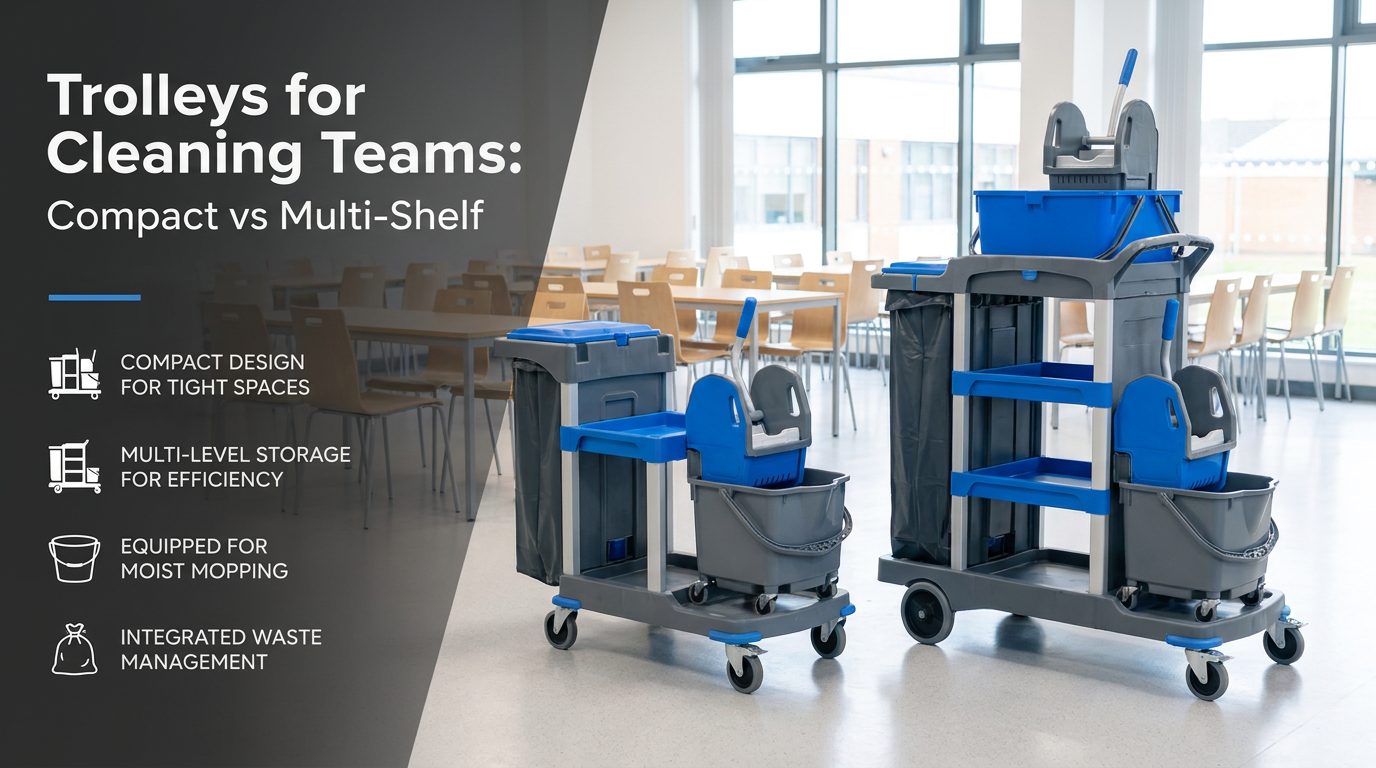
Choosing the wrong cleaning trolley doesn't just look untidy, it slows a cleaning team down every single day. A trolley that's too large to get through a corridor doorway, or one too small to carry a full colour-coded set of supplies, means extra trips back to the storeroom multiplied across every shift, every day, for as long as it stays in use.
This comparison looks at compact and multi-shelf trolleys specifically, and where each one actually earns its place in a school cleaning operation.
What compact trolleys are built for
Compact trolleys are designed around manoeuvrability first. They typically carry two to three colour-coded compartments rather than a full four or six-colour set, and they're built narrow enough to move through tighter corridors and doorways without staff needing to angle or reverse them through gaps.
This makes them well suited to older school buildings, particularly Victorian and early twentieth-century sites where original corridor widths can sit under 1.2 metres in places. A larger trolley simply won't clear some of these spaces without staff resorting to carrying supplies by hand for part of the round, which defeats the purpose of having a trolley at all.
Compact trolleys also suit teams covering smaller sites or specific zones, such as a caretaker responsible for a single wing or a nursery attached to a larger school, where the full range of colour-coded supplies for an entire site simply isn't needed on one trolley at once.
Where compact trolleys fall short
The trade-off is capacity. A compact trolley needs restocking more often through a shift, which works fine for a focused zone but becomes inefficient for a cleaner covering a large, sprawling site where a return trip to the storeroom eats into actual cleaning time.
What multi-shelf trolleys are built for
Multi-shelf trolleys are built around capacity and full colour-coding. A typical multi-shelf unit carries a complete four-colour system, red for washrooms, blue for general areas, green for catering, yellow for clinical or isolation areas, with enough shelf space for spray bottles, cloths, refuse sacks and hand tools all in their correctly separated sections.
This suits larger secondary schools, multi-building sites, and any setting where a single cleaner or team covers substantial ground in one shift. Restocking less frequently means more actual cleaning time per shift, which matters most on sites where the storeroom might be a genuine walk away from the areas being cleaned.
Where multi-shelf trolleys fall short
The obvious limitation is size and weight. A fully loaded multi-shelf trolley can weigh well over 20 kilograms once stocked, and manoeuvring that weight through narrow doorways, tight stairwells or older corridors is both slower and, over time, more physically demanding on staff. Wheel quality matters considerably here: smaller 75mm castors struggle on anything other than smooth hard flooring, while 100mm castors handle transitions between carpet and hard floor, and door thresholds, with far less resistance.
Comparing the two side by side
For a site with wide modern corridors, multiple buildings and a cleaning team covering substantial floor area per shift, a multi-shelf trolley with full colour-coding will almost always work out more efficient over a full working day, despite being harder to manoeuvre in tight spots.
For a site with narrow older corridors, a smaller footprint, or a team split across several confined zones, a compact trolley trades some capacity for the ability to actually get through the building without detours, which in practice often saves more time than the extra restocking costs.
Many schools end up running both: multi-shelf trolleys for main building rounds and compact trolleys for older wings, nursery areas or tightly built extensions where a full-size trolley simply can't operate efficiently.
Colour coding and compliance
Whichever trolley type is chosen, the colour-coding system needs to be genuinely usable, not just present. A compact trolley with only two or three compartments needs a clear protocol for how the remaining colours are covered, whether that's a second small trolley, a wall-mounted store for less frequently used categories, or a colour rotation based on which zone is being cleaned that shift.
Inspectors and auditors generally focus less on which trolley type is used and more on whether cross-contamination risk is actually being managed. A compact trolley used correctly with a clear protocol for the missing colours will satisfy this far better than an oversized multi-shelf trolley where colours have drifted and cloths get mixed back together out of convenience.
Durability and maintenance
Trolley frames take a steady beating from daily use, particularly around corners and doorframes, and it's worth checking frame welds and joints periodically rather than only when something visibly breaks. Castors are the component that fails most often, and keeping a small stock of replacement wheels on hand avoids a trolley being taken out of service for days while a specific part is ordered.
Handles and grips wear faster on trolleys used across multiple shifts by different staff, and a worn or loose handle is both a comfort issue and, eventually, a safety one if it fails while the trolley is loaded and in motion.
Making the decision
The right starting point is mapping the actual building, not the catalogue. Walking the corridors that a trolley will need to travel, measuring the tightest doorway or turn it will have to clear, and counting how many colour-coded categories genuinely need to be on hand at once gives a far more reliable answer than choosing based on trolley size alone. Teams working across several sites with a mix of old and new buildings often keep both trolley types in rotation, sourcing them from a single supplier such as Express Cleaning Supplies to keep spares and colour-coded accessories consistent across the fleet.
Training staff on trolley protocols
A new trolley, whichever type is chosen, only works as well as the routine built around it. Staff need to know exactly which colour goes where, what to do when a compact trolley doesn't cover every category on a given round, and how to report a fault rather than continuing to use a trolley with a failing castor or a loose handle because it's still technically usable.
This matters more with mixed fleets. A team running both compact and multi-shelf trolleys across different zones needs a clear, written note of which trolley belongs where and why, so a well-meaning member of staff doesn't move a multi-shelf trolley into a corridor it can't actually navigate because it happened to be free that morning.
Budgeting and fleet planning
Trolleys are a longer-term purchase than most consumable cleaning supplies, and it's worth planning replacement cycles rather than reacting when a unit finally fails. A well-maintained trolley, with castors and handles replaced as they wear rather than left to fail, typically lasts several years longer than one run to breaking point, which makes a small ongoing spares budget considerably cheaper than periodic full replacement.
For schools building out a fleet across multiple buildings, it's worth costing compact and multi-shelf trolleys separately against how many of each a full site survey actually calls for, rather than standardising on one type for simplicity. A site that needs three compact trolleys for older wings and two multi-shelf units for the main block will usually spend less overall, and lose less time to inefficient rounds, than a site that buys five identical trolleys regardless of where they'll be used.
Storage and end-of-shift routines
Where a trolley is parked between shifts matters almost as much as the trolley itself. Chemicals stocked on any cleaning trolley need to be secured out of reach of pupils overnight, either in a locked cupboard the trolley is wheeled into, or with lockable compartments built into the trolley itself if a dedicated storage room isn't available on every floor. Leaving a fully stocked trolley in an open corridor overnight is a common and easily avoidable compliance gap, particularly in primary settings.
The trolley itself also needs periodic cleaning, not just the supplies it carries. Spray bottle residue, spilled liquids and general grime build up on trolley surfaces and castors over weeks of use, and a trolley that hasn't been wiped down in months becomes a hygiene issue in its own right, working against the exact cross-contamination control the colour-coding system is meant to provide.
FAQ
Can one trolley type cover an entire school site? It depends on the building. Modern, wide-corridor sites can usually run entirely on multi-shelf trolleys, while older or mixed-building sites often need at least one compact trolley for areas a larger unit can't reach.
How many colour-coded compartments does a school cleaning trolley need? Most schools work to a four-colour system: red for washrooms, blue for general areas, green for catering, and yellow for clinical or isolation areas, though a compact trolley may only carry two or three at once.
What castor size is best for a school cleaning trolley? 100mm castors generally handle the mix of carpet, hard flooring and door thresholds found in most schools better than smaller 75mm castors, particularly on multi-shelf trolleys carrying more weight.
How often should trolley castors be replaced? There's no fixed schedule, but castors showing visible wear, sticking, or difficulty rolling in a straight line should be replaced promptly, since a struggling castor puts extra strain on the frame and on the person pushing it.