




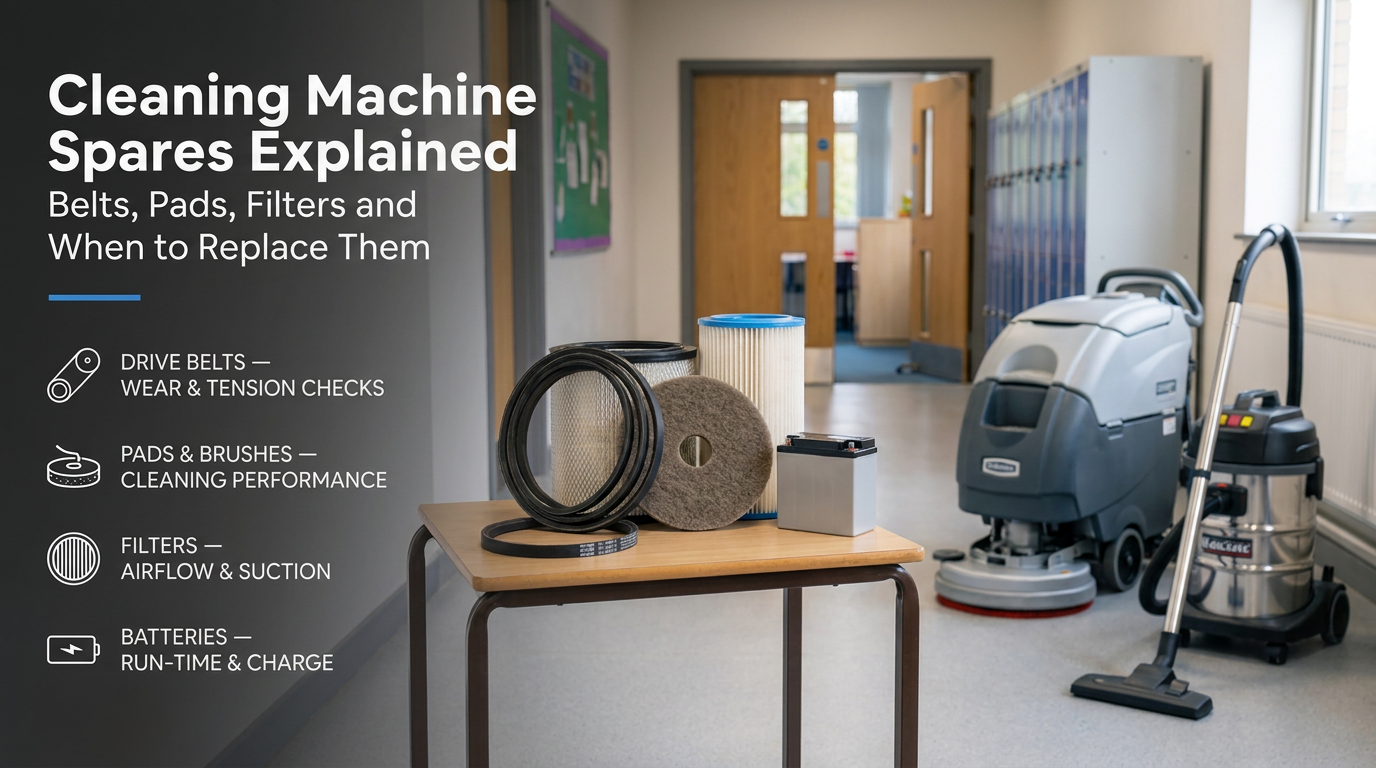
"Is this part actually worn out, or does it just look a bit tired?" is one of the more common questions facilities teams end up asking about their scrubber dryers and vacuums. Belts, pads, filters and batteries all wear gradually rather than failing outright, which makes it genuinely hard to know when a part has crossed from "still fine" into "actually affecting performance." This explainer works through each spare in turn, with the specific signs that mean it's time to replace it.
How do I know when to replace a drive belt?
A drive belt rarely fails without warning. The signs to listen and look for are a squealing or slipping noise when the machine starts up, visible cracking or a shiny, glazed look along the belt surface, and a brush that spins visibly slower than it should even with the machine running at full power.
If any one of these shows up, the belt is worth replacing rather than monitoring, since a belt that fails completely mid-shift causes far more disruption than a planned five-minute swap. A belt that's been in continuous use since the last full service is also worth a visual check even without obvious symptoms, since deterioration doesn't always announce itself with noise.
How do I know when to replace floor pads or brushes?
Floor pads wear unevenly, and the tell isn't always obvious from a quick glance. Run a hand across the pad surface: if the texture has smoothed out compared to a new pad, or one section has visibly thinned more than the rest, it's no longer agitating the floor the way it should. Streaking on a floor that used to come up clean is often the first practical sign something's changed with the pad rather than the chemical or the technique.
Brushes should be checked for bristle length and firmness. Bristles that have shortened noticeably, or gone soft rather than staying firm under pressure, won't lift dirt out of carpet fibres or grout lines the way a fresh set will. If cleaning results have quietly declined over a few weeks without an obvious cause, worn brushes are worth checking before anything else.
How do I know when to replace a filter?
Filters are the trickiest spare to judge, because a machine can keep running with a struggling filter for weeks before anyone notices. The clearest sign is a gradual drop in suction or airflow, the kind that's easy to explain away as "the machine's just getting older" rather than recognise as a filter problem.
A visual check helps confirm it: a filter that's visibly discoloured, or has a noticeable buildup of debris when held up to the light, has almost certainly been underperforming for some time already. Building a filter check into a regular maintenance routine, rather than waiting for suction to become obviously bad, catches this before it affects cleaning quality.
How do I know when to replace a battery?
Batteries in scrubber dryers and vacuums lose capacity gradually as part of normal ageing, not because something's gone wrong. The practical sign is run time: if a machine that used to comfortably finish a full round now needs recharging partway through, or seems to lose power faster in the last stretch of a shift than it used to, the battery has likely dropped below the capacity the site actually needs.
This is worth checking proactively rather than reactively, since discovering a battery can't finish a round happens most often during a busy week, exactly when there's least time to deal with it.
Finding the right spare for your machine
Spares aren't interchangeable across brands, and matching the correct part to the correct machine matters more than it might seem. Express Cleaning Supplies stocks spares across the major brands found on most sites, including Numatic, Truvox, Prochem, Viper and I-Team, covering belts, brushes, filters, batteries and the smaller electrical and mechanical parts that go with them. Knowing the exact brand and model of each machine before ordering avoids the common problem of a spare arriving that's close, but not quite right.
How often should a machine get a full service, not just a spares check?
A spares check catches individual worn parts, but it's not the same as a full service, and it's worth knowing the difference. A full service typically covers everything a visual and functional check would, plus a deeper look at components that don't show obvious wear signs day to day, seals, internal wiring, and moving parts that aren't easily visible without opening the machine up.
Most sites find an annual full service, alongside more frequent spares checks in between, catches problems that a quick visual inspection alone would miss. Machines used heavily across a large site benefit from checking this more often, since the gap between "still working" and "due a service" closes faster under heavier use.
Is it ever worth replacing the machine instead of the part?
Sometimes a spare part swap isn't the most sensible option, particularly on an older machine where several components are approaching the end of their working life at once. If a machine needs a belt, a filter and a battery within the same few months, it's worth stepping back and asking whether the combined cost and downtime of multiple spares is actually more than a newer, more reliable machine would cost over the same period.
There's no fixed rule for this, since it depends heavily on the specific machine, how it's used, and what spares actually cost for that model. But it's a question worth asking explicitly rather than defaulting to "replace the part" every time simply because that's the smaller cost in the moment.
Why replacing early is usually cheaper than replacing late
It's tempting to keep a worn part running until it fails outright, but this rarely saves money in practice. A belt or pad replaced while it's still functioning, just past its best, is a planned five-minute job. The same part left to fail completely often takes a machine out of service entirely, sometimes mid-clean, and turns a small spares order into an urgent one with less flexibility on delivery timing.
Keeping a small stock of the fastest-wearing spares, belts, filters and pads in particular, on site rather than ordering only once something breaks, is the single biggest factor in avoiding unplanned downtime.
Where spares checks fit into a wider maintenance routine
Spares checks work best as part of a regular routine rather than a one-off task done whenever something feels off. Building a quick belt, pad, filter and battery check into an existing weekly or monthly cleaning schedule, rather than treating it as a separate job that competes for time, means it actually happens consistently rather than getting pushed back whenever the team is busy.
It's also worth assigning the check to a specific person or role rather than leaving it as a general responsibility. A task that belongs to everyone in theory often ends up belonging to no one in practice, and a machine that goes unchecked for months is far more likely to fail at an inconvenient moment than one that's part of someone's actual routine.
FAQ
What's the most common sign a drive belt needs replacing?
A squealing or slipping noise on start-up, along with visible cracking or a slower-spinning brush at full power.
Can a filter still work if it looks slightly dirty?
It can, but performance drops well before a filter looks obviously bad, so a gradual loss of suction is a more reliable sign than visual condition alone.
How do I know if it's the battery or the machine that's the problem?
If run time has shortened gradually over weeks or months without any other fault, it's almost always the battery reaching the end of its useful capacity rather than a fault with the machine itself.
Are cleaning machine spares brand specific?
Yes. Belts, pads, filters and batteries are generally made for specific machine brands and models, so it's worth confirming the exact machine before ordering a replacement part.
How often should I check spares if I don't have time for a full routine?
Even a quick monthly visual check of belts, pads, filters and battery performance catches most developing issues before they cause downtime, and it's considerably better than no routine check at all.