



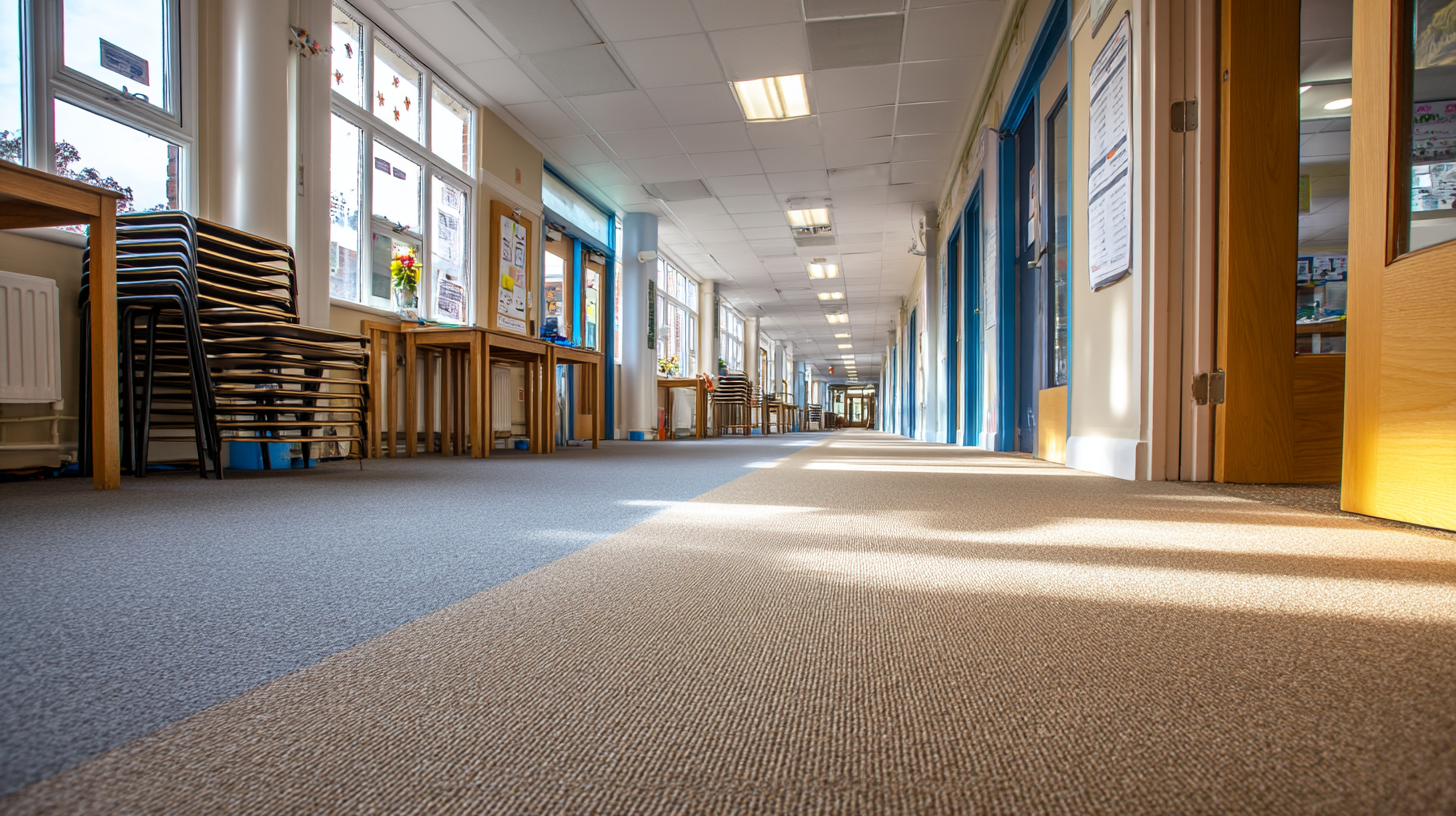
Carpeted areas in schools work harder than they look. Classrooms pick up pencil shavings, crumbs and spill marks. Libraries hold dust in quieter corners. Offices see chair track marks and tea stains. Entrance mats take the worst of wet shoes, mud and grit before anyone has reached the corridor.
That is why carpet cleaning for schools needs a more planned approach than a quick vacuum and a spot spray. Between terms, site teams finally get the access needed to deal with deeper soil, odour and staining. However, the method matters. Dry carpet cleaning and extraction cleaning both have a place, but they solve different problems.
At Express Cleaning Supplies, we help schools, offices and education sites choose practical carpet cleaning equipment based on access, drying time, disruption and floor condition. Our carpet cleaning range includes dry carpet cleaners, portable extractors, spotters, detergents, deodorisers and accessories suitable for schools and commercial buildings.
The main difference between dry and extraction cleaning
Dry carpet cleaning uses a low-moisture compound or powder worked into the carpet pile, then vacuumed away once it has absorbed soil and moisture. It suits areas that need to return to use quickly, because the carpet stays largely dry.
Extraction cleaning, often called hot water extraction or spray extraction, injects cleaning solution into the carpet and removes it with vacuum recovery. It gives a deeper clean, especially where soil, stains and odours have settled into the fibres. However, it needs more planning because the carpet must dry properly before pupils, staff or visitors return.
The choice is not about which method is “better”. In practice, the best method depends on the space, the soil level and how much drying time you can realistically allow.
When dry carpet cleaning makes sense
Dry carpet cleaning for schools works best where disruption matters more than heavy restoration. For example, a library that needs to reopen after half-term, a staff office that cannot be out of use for a full day, or a sixth form study room with moderate wear may all suit a dry process.
The SEBO Duo Dry Carpet Cleaner is a good example of this type of machine. It uses twin contra-rotating brushes, is designed to avoid wet cleaning problems such as shrinkage, and helps lift and restore carpets without a wet extraction process.
Similarly, the Prochem Fiberdri TM4 Dry Carpet Cleaning Machine is positioned as a cost-effective dry maintenance method. It is designed for all carpet types, keeps the carpet dry and operates at a low noise level, which can be useful in schools and offices where some areas remain occupied.
Where dry cleaning performs well
Dry cleaning is particularly useful for:
- Libraries and reading areas
- Staff rooms and admin offices
- Classrooms with light to moderate soil
- Carpeted meeting rooms
- Areas with limited ventilation
- Sites where fast reoccupation matters
However, dry cleaning is not a magic fix for every carpet. If the carpet has deep drink spills, tracked-in mud, body odour, heavy food residues or repeated staining, extraction cleaning will usually give a more thorough reset.
When extraction cleaning is the better choice
Carpet extraction for schools is the stronger option when the carpet needs deeper cleaning. It helps remove embedded dirt, stains and odours from fibres, which makes it useful during summer holidays, Christmas closures and longer half-term breaks.
Express Cleaning Supplies’ cleaning machine range describes carpet cleaning machines as equipment that injects cleaning solution deep into fibres to remove built-up dirt, stains and odours. That makes extraction especially relevant for entrance areas, corridors with carpet tiles, nurseries, offices, libraries and high-use classrooms.
For smaller spaces and spot cleaning, the Viper Wolf130 Hand Operated Carpet Extractor is a practical option. It is described as lightweight, portable and suitable for daily use in offices, healthcare facilities and schools, particularly for spills, stains and dirt.
For broader school use, the Express Solutions Portable Pro offers powerful deep cleaning, enhanced suction, faster drying and quiet operation. It is positioned for carpets, upholstery and commercial spaces, which makes it suitable for schools wanting one flexible machine for term-break cleaning.
Drying time is the operational deal-breaker
Drying time should drive the decision as much as cleaning performance. A carpet that looks clean but remains damp can create odour, re-soiling and access problems. In a school, that can quickly interfere with classroom setup, office use or holiday club provision.
HSE guidance on cleaning and slips highlights that wet or drying floors need careful access control, suitable cleaning methods and proper training. Although carpet is different from smooth hard flooring, the same operational principle applies. If the floor is not ready for safe use, the area needs to stay controlled.
For this reason, extraction cleaning is best scheduled when the site can support drying. Ventilation, airflow, heating, humidity and carpet thickness all affect turnaround time. Meanwhile, dry carpet cleaning gives schools more flexibility where time is tight.
A simple rule works well. Use dry cleaning for maintenance and fast access. Use extraction cleaning when you have time to reset the carpet properly.
Match the method to the school space
Classrooms
Classrooms usually need a balanced approach. Dry carpet cleaning can maintain appearance between terms, especially where the carpet only has light soil. However, extraction may be needed after art spills, food residues, drink marks or a full academic year of wear.
If a classroom must be reset quickly, dry cleaning is often the safer operational choice. If the room is empty for several days, extraction gives a deeper result.
Libraries and study areas
Libraries often suit dry carpet cleaning because they tend to have lower soil levels but need minimal disruption. A low-noise dry machine can be useful where parts of the building stay open during holidays.
That said, extraction still has a role if the library has soft seating, coffee marks or musty odours. In that case, a portable extractor and upholstery tool may offer more targeted cleaning than a full-room process.
Offices and staff areas
Offices usually have chair marks, coffee stains and dust build-up along edges. Dry cleaning can refresh the carpet with limited downtime. However, extraction helps more when stains sit under desks or where odour has built up over time.
For school upholstery cleaning, machines such as the Prochem Galaxy Compact Carpet and Upholstery Cleaning Machine are worth considering. The Galaxy Compact is described as lightweight and compact, with a two-stage vacuum, 150 psi pump and suitability for carpets, rugs, upholstery, spotting and small commercial areas.
Entrances and matting
School entrance mat cleaning needs a tougher approach because these areas collect grit, moisture and outdoor soil. Dry cleaning may help maintain appearance, but extraction is often more effective where mats are heavily loaded with dirt.
In practice, entrance mats should be cleaned before they start transferring soil into the rest of the building. If the entrance mat fails, the cleaning burden moves into corridors and classrooms.
Do not ignore detergents and accessories
A school carpet cleaner is only part of the system. Detergents, pre-sprays, defoamers, stain removers, brushes, hand tools and rinse products all affect the final result.
For extraction work, Prochem Contract Carpet Extraction Cleaner is a low-foam detergent concentrate suitable for carpet soil extraction machines and most carpets, subject to pre-testing. Low-foam products matter because excess foam can interfere with recovery tanks and machine performance.
For schools wanting a WoolSafe-approved option, Prochem Extraclean 5L is described as an advanced micro-encapsulation extraction cleaner for carpets, rugs and upholstery, with a lemon fresh fragrance.
For dry cleaning, Prochem Fiberdri 1kg Sachet is a dry carpet cleaning compound and spill absorbent made from a natural organic base with biodegradable ingredients. It absorbs soil and moisture, and carpets can be used immediately after cleaning.
Accessories also matter. Stair tools, upholstery tools and hand tools help schools deal with steps, soft seating, staff chairs and awkward corners without over-wetting areas or relying on unsuitable equipment.
Stain removal and odour control
Schools deal with predictable stains. Drinks, mud, food, paint, bodily spills, ink and unknown marks all appear at some point. Therefore, spot treatment should happen before full carpet cleaning, not after.
Extraction cleaning usually performs better on deeper stains because it flushes and recovers soil from the carpet. However, dry compounds can be useful for fresh spills and light soiling where moisture must stay low.
Odour control also needs source removal. A fragrance alone will not fix a carpet that holds organic residue. In spaces such as early years rooms, libraries, changing area entrances and offices with soft seating, a planned clean with the correct detergent or deodorising product often works better than repeated surface sprays.
Cost, labour and disruption
For B2B decision makers, the cheapest method is not always the lowest-cost method. Dry carpet cleaning may cost less in downtime because rooms return to use faster. Extraction may cost more in labour and drying time, but it can extend carpet life and reduce repeat complaints when carpets are heavily soiled.
The right buying decision depends on how often the school plans to clean. If you only need occasional spot cleaning, a compact extractor may be enough. If you manage several buildings, a more capable machine and accessory set may give better value over time.
HSE also reminds employers that cleaning equipment is only effective if it is well maintained, and that staff need the right information, instruction and training. For schools, that means filters, tanks, hoses, brushes and chemical dosing cannot be afterthoughts.
Practical checklist for choosing a school carpet cleaner
Before buying or replacing equipment, ask:
- Which areas are carpeted, and how heavily are they used?
- Do you need a fast turnaround, deep cleaning, or both?
- Can the school provide ventilation and drying time after extraction?
- Are carpets wool, synthetic, carpet tiles or entrance matting?
- Do you need upholstery and stair tools as well as a carpet wand?
- Will staff use the machine, or will contractors handle term-break cleans?
- Can you store detergents safely and follow COSHH requirements?
- Are compatible spares, brushes, filters and chemicals easy to reorder?
- Would dry cleaning reduce disruption in offices or libraries?
- Would extraction give better value for entrances and stained classrooms?
If those questions are clear, the buying decision becomes much easier.
FAQs
Is dry carpet cleaning better for schools?
Dry carpet cleaning is better when schools need fast reoccupation, low disruption and light to moderate maintenance cleaning. It is especially useful for libraries, offices and study spaces.
Is extraction cleaning better for stained carpets?
Yes, extraction cleaning is usually better for deeper soil, stains and odours because it applies cleaning solution into the fibres and recovers the dirty solution.
Can one school carpet cleaner handle carpets and upholstery?
Some machines can. For example, the Prochem Galaxy Compact is designed for carpets, rugs, upholstery, spotting and small commercial areas. However, schools may need the correct hand tools for chairs, stairs and soft furnishings.
How should schools clean entrance mats?
Entrance mats need regular vacuuming and periodic deeper cleaning. Extraction often works well where mats hold grit, moisture and outdoor soil, while dry methods can help with maintenance between deeper cleans.
What is the best carpet cleaning method between terms?
For short half-terms, dry cleaning often reduces disruption. For longer holidays, extraction cleaning gives a deeper reset, especially in classrooms, entrances and high-use offices.
What should schools buy first?
Start with the problem. If spills and stains are the issue, choose a portable extractor or spotter. If downtime is the issue, look at dry carpet cleaning. If upholstery and carpets both need attention, choose a machine and accessory setup that supports both.
At Express Cleaning Supplies, we do not see carpet cleaning as a one-machine decision. Schools get better results by matching the method to the space, choosing compatible detergents and planning cleaning around term dates, access and drying time. Done properly, carpet cleaning becomes less disruptive, more predictable and far easier to budget.