



A school-run Bonfire Night event brings together several risks that do not usually overlap on a normal school day: open flame, fireworks, a large outdoor crowd, and an evening setting with reduced visibility. Getting fire safety, first aid and the practical outdoor event supplies right before the night itself matters just as much as the display or bonfire being well organised.
This guide works through what to prepare across all three areas, so the evening runs safely from the moment gates open to the final walk-round once everyone has gone home.
Why a school Bonfire Night needs broader planning than a normal event
Most school events happen indoors, during the day, with a crowd that rarely exceeds what the building was designed for. A Bonfire Night event flips all of that. It happens outdoors, after dark, and typically draws a larger crowd of parents, siblings and local visitors than a usual school event, onto a site that was not necessarily designed with an evening outdoor gathering in mind.
That combination is exactly why fire safety, first aid and general outdoor event supplies all need separate attention rather than treating the evening as simply a bigger version of a normal school event.
Fire safety around the bonfire and display area
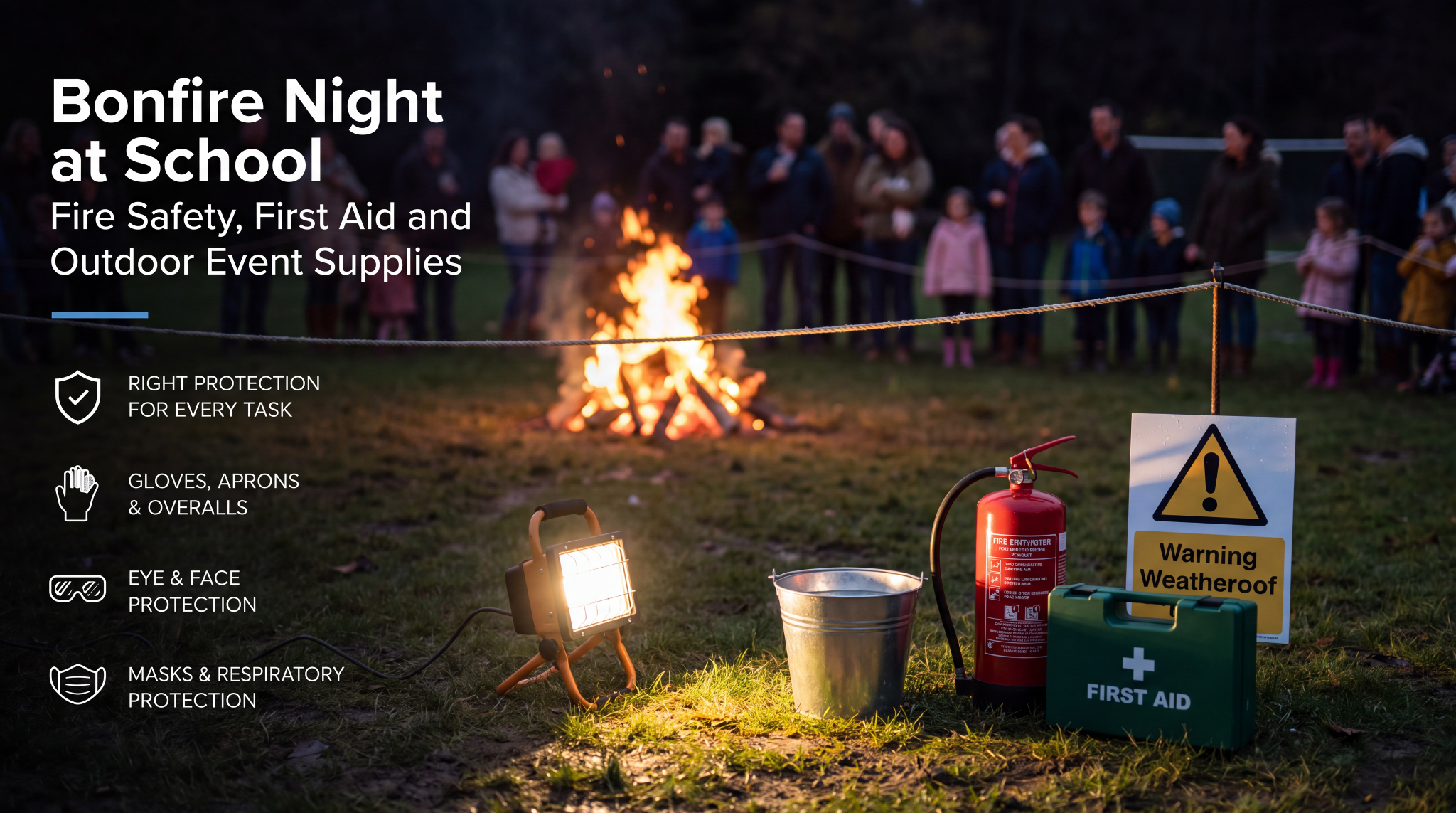
A bonfire and firework display both need a clearly defined safety perimeter, kept well back from the crowd and marked clearly enough that it is obvious even in low light. Warning signs and barriers around this area are not a formality. They are what stops a curious child, or simply someone not paying close attention, wandering closer than is safe.
Fire extinguishers and a water supply need to be positioned near the bonfire itself, not stored elsewhere on site where they would take valuable time to reach in an emergency. It is worth confirming who on the team is responsible for these specifically, rather than assuming general event stewards will know where they are kept.
The period after the bonfire and display end carries its own fire risk that is easy to underestimate. Embers can stay dangerously hot for far longer than they appear to from a distance, so the bonfire needs proper monitoring well after the main event finishes, not left unattended once the crowd starts to disperse.
First aid provision for the evening
A standard classroom first aid kit is built for minor daytime injuries and does not reflect the actual risk profile of an evening firework event. Burns are the injury most specific to this kind of occasion, so burn dressings and appropriate cooling provision need to be part of the kit, alongside the plasters and general wound care items a school would normally carry.
Eye care supplies deserve particular attention given the realistic risk from smoke, sparks and airborne debris around a firework display. Having eye wash readily accessible, rather than packed away in a general kit that needs to be located first, means a minor issue can be dealt with quickly rather than becoming worse while someone searches for the right item.
Positioning matters as much as content. A single first aid station at one end of the site does little good for an incident happening at the opposite end of a large outdoor event, so spreading kits across several accessible points, clearly signed or known to all stewards, cuts down response time wherever something happens.
Outdoor event supplies that keep the evening running smoothly
An outdoor evening event in early November needs supplies that a typical indoor school event never has to think about. Weatherproof signage, rather than paper signs that will not survive a damp evening, keeps safety information legible for the full duration of the event regardless of conditions. Lighting around walkways, entrances and the first aid points themselves matters just as much, since reduced visibility is one of the defining differences between this event and a normal daytime one.
PPE for staff needs to reflect the outdoor evening setting too. Warm, weatherproof clothing matters as much as the usual gloves and protective items, since stewards are often standing outside for an extended period in conditions considerably colder than an indoor event would involve. Disposable gloves remain useful for food service and any minor first aid during the evening, but cold and wet protection for staff is just as much a practical safety consideration as any of the fire-specific preparation.
Coordinating everyone involved in the event
A Bonfire Night event typically involves people beyond core school staff, PTA volunteers running stalls, an external fireworks contractor, and sometimes local fire service representatives. Sharing fire safety and first aid information with everyone involved, not just permanent staff, avoids a situation where a volunteer at a stall has no idea where the nearest extinguisher or first aid kit is.
A short briefing covering the whole team before gates open is worth the time it takes. It also helps to agree clearly in advance who has final responsibility for safety decisions on the night, particularly if weather or an unexpected issue means a quick call needs to be made about pausing or adjusting the event.
After the event: the final check
Once the crowd has left, the site still needs a proper check before anyone considers the evening finished. Firework debris should be cleared rather than left until the following morning, particularly from areas students will walk through before staff have a chance to check the site again in daylight. The bonfire area needs a final confirmation that everything is genuinely out, not just no longer visibly burning, before the site is left unattended for the night.
Weather contingency for an outdoor fire safety event
An outdoor event held in early November is always subject to whatever the weather does on the night, and wet or particularly cold conditions change the fire safety and first aid picture considerably. Rain increases slip risk on top of the usual uneven-ground hazards around an outdoor site, and a longer, colder evening raises the chance of staff and attendees becoming genuinely cold rather than just mildly uncomfortable.
Deciding in advance where people could shelter if conditions worsen, and making sure stewards know that plan before gates open, avoids a scramble if the weather turns partway through the evening. It is also worth confirming that any outdoor first aid kits and fire safety equipment are stored somewhere that keeps them dry and usable, since equipment left exposed to rain for several hours may not work as intended when it is actually needed.
Keeping a simple record for next time
A brief written record of how the evening went, what worked, what needed adjusting on the night, and any incidents however minor, is worth keeping even when the event runs smoothly. This kind of record builds into a genuinely useful reference over several years, showing which parts of the plan hold up well and which need revisiting before the next event.
It also gives a new member of staff organising a future event a concrete starting point, rather than relying on whoever was involved the previous year remembering the details informally. A short debrief shortly after the event, while everything is still fresh, tends to capture more useful detail than trying to reconstruct it months later when planning for the following year begins.
Checking local guidance before the event
Requirements and recommendations for running an outdoor fire and firework event can vary depending on the site and local area, so it is worth checking with the local fire service or relevant local authority contact well ahead of the event, rather than relying solely on what was done the previous year. This is particularly useful for a school running the event for the first time, or after any changes to the site layout since the last one took place.
This kind of check costs little time but can surface site-specific points, access for emergency vehicles, suitable distances for a particular layout, that are easy to miss when planning from memory or from a generic checklist alone.
FAQ
Where should fire extinguishers be kept during a school Bonfire Night event? Close to the bonfire and display area itself, with a specific person responsible for knowing their location, rather than relying on stewards to locate them during an emergency.
What first aid items are most specific to a firework and bonfire event? Burn dressings, appropriate cooling provision and eye care supplies address the particular risks of this kind of event, alongside the plasters and general first aid items a school would normally carry.
Does outdoor event PPE differ from what staff would use during a normal school day? Yes. Warm, weatherproof clothing becomes a genuine safety consideration for an evening outdoor event, in addition to the gloves and protective items used for food service and first aid.
How long after the display ends should the bonfire still be monitored? Considerably longer than it might appear necessary. Embers can remain dangerously hot well after a fire looks like it has died down, so the area needs checking rather than being left unattended as soon as the crowd disperses.